
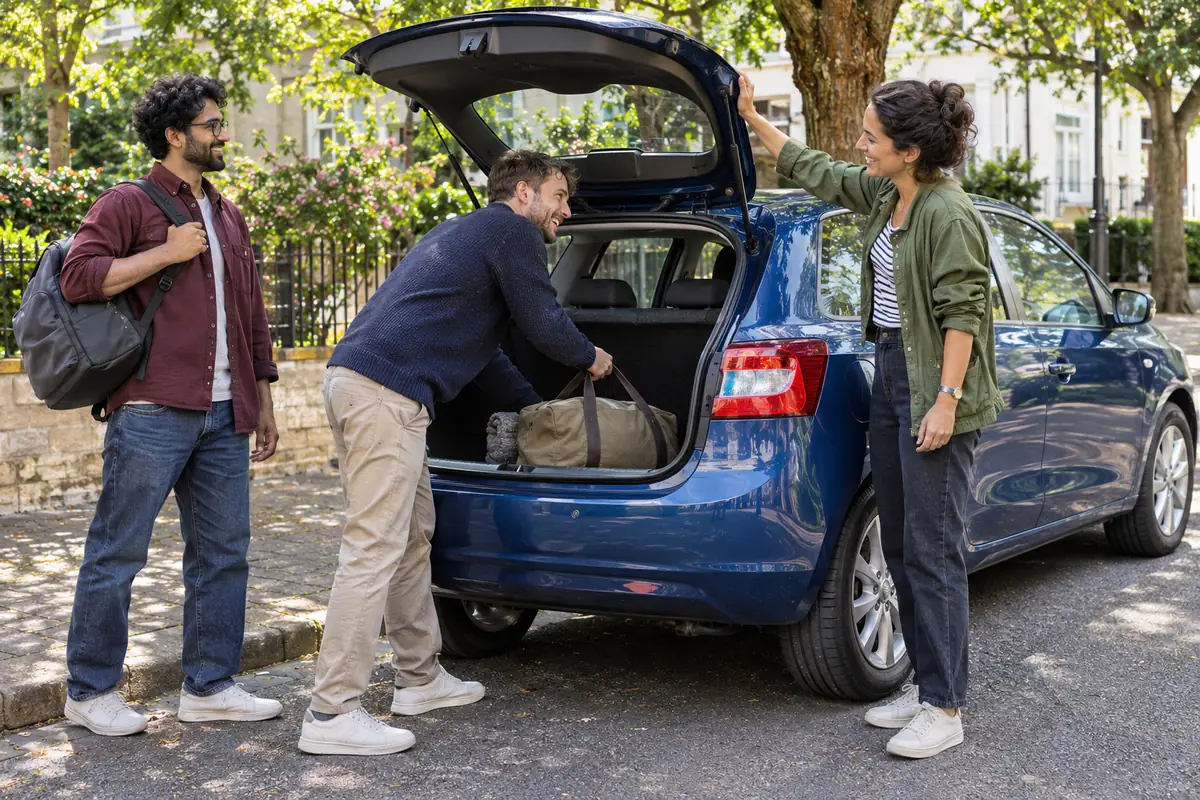
Car sharing means using a vehicle that several people access in turn, instead of owning one. Members book a car for a few minutes, hours or days, unlock it with an app or card and pay according to use. The idea covers company-run fleets, cars parked at fixed stations, vehicles left anywhere inside a city zone and private cars lent between neighbours. It suits people who drive occasionally, since fuel, parking and maintenance are handled by the operator or split among users, and a single shared vehicle can replace several privately owned ones.
The main car sharing models
Not all shared cars work in the same way, and the differences matter when you compare offers. Three families dominate.
- Station-based: each car has a reserved bay. You collect it there and bring it back to the same place, which makes availability predictable.
- Free-floating: cars are parked on ordinary streets inside an operating zone. You find the nearest one on a map and end the trip anywhere in the zone, which is handy for one-way journeys.
- Peer-to-peer: private owners rent their own car to other members through a platform that handles the booking, insurance and payment.
Some operators combine two of these formats in the same city, so it is worth checking which one you are actually booking before you leave home.
How to join and book a shared car
Joining is usually quick, but it is not instant. Expect to follow a short sequence of steps before your first trip.
- Create an account in the operator's app and enter your personal details.
- Upload a valid driving licence. Most operators ask for a minimum licence age or a minimum number of years behind the wheel.
- Add a payment card and, where required, pay a registration or deposit amount.
- Wait for the licence check, which can take minutes or a couple of days.
- Book a car, walk to it, unlock it with the app or a member card and drive.
Before setting off, walk around the car and report scratches in the app, so that you are not held responsible for earlier damage.
If you plan to drive abroad, check the terms first, as some providers restrict cross-border use.
What car sharing costs
Pricing differs from one provider to the next, but most combine a few elements. Some charge a monthly or annual membership, others only a small joining fee. The trip itself is billed by the minute, hour, day or kilometre, and fuel or charging is often included in the rate. Insurance is normally part of the price, with an excess that you pay if there is damage.
To judge whether it is worth it, add up what a private car costs you in a year: purchase or finance, insurance, tax, servicing, parking and fuel. Divide that by the number of trips you really make. Many occasional drivers find that using a shared car for a few journeys a month costs less than owning one, while people who drive every day usually do not.
Always read the tariff for long trips, since daily caps and kilometre allowances vary a lot.
Who benefits most from sharing a car
The model works best when a car would otherwise sit unused. Typical users include city residents who walk, cycle or take public transport most days but need a vehicle for a weekend trip, a furniture run or a large shop. Students and young workers who cannot yet afford a car also use it, as do households that want to give up a second vehicle.
Small businesses and associations use shared fleets as well, so that they pay only when a vehicle is genuinely needed. Retired people who drive a few hundred kilometres a year sometimes find it easier than keeping a car for rare outings.
It suits less well those who commute long distances by car every day, families who need a child seat permanently installed, or anyone living far from the operating area of any provider.
Practical rules of the road for shared vehicles
Using a shared car is easy, but a few habits keep it that way for the next member. Return the vehicle on time, because late returns can block the next booking and are often charged. Leave it clean, without rubbish, and respect any no-smoking rule. Refuel or recharge when the car asks for it, and report warning lights straight away.
Keep the booking confirmation and the check-in photos until the trip is billed, as they are your proof in a dispute. Know what to do after an accident: stay safe, call emergency services if anyone is hurt, record the details of the other party, and contact the operator through the number given in the app.
Fines for parking or speeding are normally sent to the operator, who then passes them to the member, sometimes with an administrative fee.
Environmental and urban effects
Supporters of shared cars point to the idea that one vehicle can serve many people and reduce the number of cars competing for street space. Several studies of city schemes have suggested that some members sell or postpone buying a car after joining, although results differ between cities and models. Free-floating fleets in particular can also attract users who would otherwise have walked or cycled, so the net effect is not the same everywhere.
Electric cars are increasingly used in shared fleets, which lowers local noise and exhaust emissions, provided charging points are available. Cities sometimes support the model with reserved parking bays or reduced fees, because it can ease pressure on kerbside space. The real benefit depends on how people change their habits: the best results appear when shared cars complement public transport rather than replace it.
Choosing the right provider
Start with coverage. A scheme that has no cars near your home or workplace is of no use, however attractive its tariff. Next, compare the type of vehicles offered, the opening hours of the customer service, the size of the insurance excess and the conditions for cancelling a booking.
- Check whether one-way trips are allowed and how they are priced.
- Look at the total cost for your typical month, not only the headline rate.
- See if the operator accepts foreign driving licences if you are new to the country.
- Read recent member feedback about vehicle cleanliness and availability.
Many people register with two services at once, for instance one station-based and one peer-to-peer, to keep a fallback when the first has no car nearby.
Car sharing organisations worth knowing
- Zipcar : Station-based car sharing service used in several countries, with cars booked by app and fuel and insurance included.
- Communauto : Pioneer of car sharing in North America, offering round-trip and free-floating cars in Canadian cities.
- Getaround : Peer-to-peer platform on which owners rent out their cars to approved members in several countries.
- SHARE NOW : Free-floating car sharing operator active in a number of European cities, with trips billed by the minute.
- Turo : Peer-to-peer marketplace where private owners list cars for short or long rentals.
Further reading
- Shared-Use Mobility Center learning resources : Independent resources explaining shared mobility models, benefits and policy questions.