
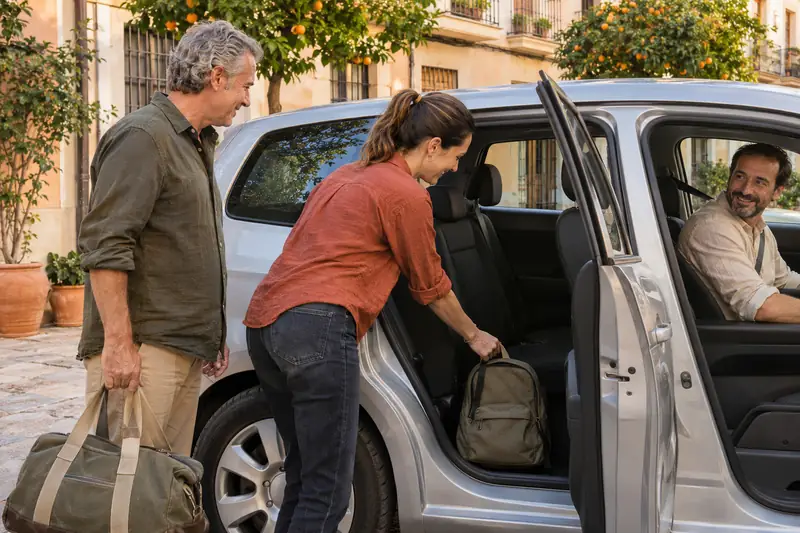
In Greece, carpooling means that a driver travelling between cities such as Athens, Thessaloniki or Patras offers free seats to passengers heading the same way, who contribute to fuel and motorway tolls. It is practised by students, seasonal workers and families, especially around holidays when roads fill up. Public coaches and trains are the main alternatives. A shared lift is not a taxi: the driver is travelling anyway and should only recover a fair part of the real cost of the journey.
Where shared journeys are most common
The principal spine of the country's road network runs from Athens north to Thessaloniki, and many shared rides follow this motorway. Other strong corridors include Athens to Patras, where the Rio–Antirrio bridge connects the Peloponnese to the mainland, and Thessaloniki to Alexandroupoli, which follows the Egnatia Odos in the north. Students returning from universities to their home towns create regular flows on Fridays and Sundays.
- Athens to Thessaloniki, a long journey that justifies sharing costs.
- Athens to Patras and the western Peloponnese.
- Thessaloniki to Ioannina along the western Egnatia.
Mountain sections can be slow and winding, so drivers should allow extra time, particularly in winter when snow affects the northern passes.
Carpooling in Greece: finding people to travel with
Greece has no single dominant national platform, so many seats are filled through social media groups, university noticeboards and personal contacts. Travellers should be aware that the offer changes by season, with more activity in summer and around Easter, the biggest family holiday of the year.
When you contact a driver or passenger, ask for a profile, a phone number and, if possible, a mutual acquaintance. Exchange details about the car, the meeting place and the luggage before confirming. Arrange the payment before leaving and settle it as agreed. If you are a driver, state clearly whether tolls are included in the contribution. Honest and early communication is what separates a pleasant trip from a stressful one, particularly on journeys of five or six hours.
Sharing the cost of fuel and tolls
Motorway tolls are significant on the main routes, and fuel prices in Greece are relatively high compared with average incomes. Together they make a single long trip costly, and sharing them among several people brings real relief to a student or a seasonal worker.
- Check the toll stations along the planned route and add their amounts.
- Estimate the fuel consumption of the car for the whole distance.
- Divide the total by the number of people, including the driver.
Pay in cash or by bank transfer, depending on what both sides prefer. Contributions should not exceed the real expense. A driver who is clear and fair from the start finds it easier to fill the seats again next time, and a passenger who pays immediately is welcomed back.
Coaches, trains and ferries as alternatives
The intercity coach network operated by regional companies, known collectively as KTEL, reaches almost every town and village, and it is often the cheapest and most flexible way to travel. Rail services have improved on the main Athens–Thessaloniki line, offering a fast and comfortable alternative for many travellers.
For the islands, the ferry is the unavoidable link, and the question becomes how to reach the port. Many passengers share a car to Piraeus, Rafina or Patras, then board the boat as foot passengers, avoiding the cost of taking the vehicle on board. Others travel together with a vehicle and split the ferry fare for the car. Checking timetables and booking tickets in advance is important in July and August, when departures are crowded.
Road safety in Greece
Greek roads range from modern motorways to narrow mountain tracks. Drivers should adapt their speed to conditions and avoid driving when tired. On the coast, summer traffic and road surfaces that become slippery after rare rain call for caution. In winter, chains may be required on some mountain routes.
- Seat belts are compulsory for everyone in the car.
- Alcohol limits are low, and enforcement is real.
- Do not use a phone while driving.
- Carry a warning triangle, a reflective vest and a first-aid kit.
Passengers can help by staying alert, sharing navigation duties and speaking up if they feel the driver is tired. A short stop for coffee costs very little compared with the risk of an accident after hours at the wheel.
Commuting in Athens and Thessaloniki
Athens is a dense and often congested city, where parking is scarce and public transport includes metro, tram, buses and suburban rail. Many residents rely on these services, but some commutes from the outer suburbs are easier by car. Colleagues living along the same route can take turns driving and share the cost of parking.
In the past, the central ring of the capital has been subject to traffic restrictions based on licence plates, so the rules for entering the centre should be checked before planning a daily route. Thessaloniki has a similar pattern of congestion at the seafront and on the ring road. A pool of two or three colleagues can reduce both costs and stress, but it needs a fixed pick-up point and tolerance for occasional changes of plan.
Students, seasonal workers and holidays
University students form the most regular group of travellers. Many study far from home, and sharing a car for weekend journeys makes the trip affordable. Seasonal workers in tourism move to islands and coastal resorts in spring and return in autumn, often travelling together with their belongings in a single vehicle.
- Plan early for Easter, mid-August and the end of December, when demand is highest.
- Bring only the luggage you have agreed to carry.
- Confirm the return trip at the same time as the outward one.
On these peak days, roads out of the cities are crowded, and leaving at an unusual hour can save time. The most important rule remains reliability: turn up on time and warn others when your plans change.
Legal and insurance points to remember
A driver who shares a trip must hold a valid licence, registration and compulsory third-party insurance. Carrying paying passengers on a regular and professional basis is a different matter and requires a transport licence, so carpooling should remain a cost-sharing arrangement between private people. If in doubt, ask your insurer how passengers are covered.
Travellers from other countries should check what documents they need in the car, including a licence recognised in Greece. Keep identity cards or passports within reach, as police checks can happen on the main routes. Following the rules protects all participants and avoids the problems that sometimes affect improvised arrangements. A short written message listing the car, the plate number and the agreed price is enough to give everyone peace of mind.
Transport services and coach operators in Greece
- KTEL : Federation of regional intercity coach companies serving cities, towns and villages across the country.
- Hellenic Train : National passenger rail operator running services between Athens, Thessaloniki and other cities.
- Beat : Ride-hailing and taxi app operating in Greek cities for local trips.
Further reading
- Visit Greece : Official tourism portal with practical information for travellers moving around the country.