
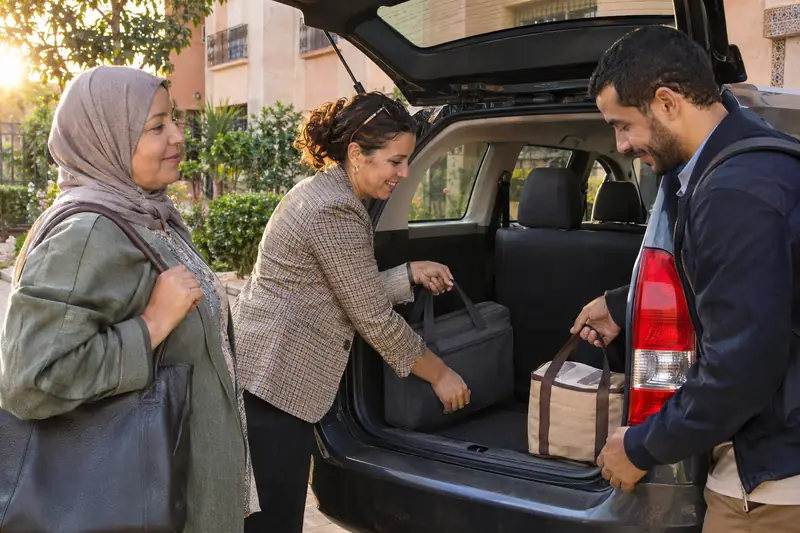
In Morocco, carpooling is a way of travelling in which a driver with free seats takes passengers going the same way, and everyone shares the cost of fuel and motorway tolls. It is used mainly between large cities such as Casablanca, Rabat, Marrakech, Tangier and Fez, and for family journeys during holidays. Rides are found through mobile apps, social media groups and personal contacts, and the practice sits alongside trains, coaches and grands taxis as a flexible option for people who want to reduce travel expenses.
Carpooling in Morocco and the intercity map
Most carpooled trips in Morocco follow the busiest corridors. The Casablanca to Rabat and Casablanca to Marrakech routes, and the link between Tangier, Rabat and Casablanca, attract the largest numbers of travellers, followed by journeys to Fez, Agadir and Oujda. The motorway network connects most major cities and makes these journeys relatively quick.
Travellers have several alternatives. The national railway runs frequent trains on the main axis, including a high-speed line between Tangier and Casablanca, and long-distance coaches serve most towns. Grands taxis operate shared journeys on set routes. A carpool is often the best option when you leave at an awkward hour, travel with luggage, or head to a place that trains do not reach.
The attraction is flexibility: the driver and passengers choose a departure time and a meeting point and divide costs among themselves.
Apps and groups used for rides
Morocco has had its own carpooling apps for several years, and a major international platform has recently entered the market with a focus on intercity routes. Local start-ups have tried different models, including long-distance journeys and daily urban commuting. Because the market is still moving, services can change quickly, and it is a good idea to compare a few of them.
Many travellers also rely on social media groups dedicated to a city or a route, where drivers post their date, time and price. These are convenient but offer less protection than a platform with verified profiles and ratings.
- Prefer services that display a real name and a photo.
- Check the reviews left by previous passengers.
- Use the in-app messaging for the first contact.
- Confirm the plan again on the day of travel.
What a ride costs
The amount depends on the distance, the price of fuel and the motorway tolls. On a route such as Casablanca to Marrakech, the cost is shared between all occupants, which makes a seat much less expensive than a car journey alone and often comparable with a coach ticket, depending on the offer. Some platforms propose a recommended contribution based on local fuel costs, and others let drivers choose within a limit.
Motorway tolls are a significant part of the cost on many routes in Morocco, and they are normally included in the shared amount. Ask beforehand whether the price covers them.
Pay the agreed amount in the way described in the app or the conversation. Where a ride is arranged through a social group, settle the amount before leaving to avoid misunderstandings. A driver who asks for much more than the real costs should be avoided.
Rules, licences and legal context
The legal position of carpooling in Morocco is still developing. Commercial passenger transport, such as taxis and coaches, requires an official licence. Private drivers who share the costs of a trip they are making anyway are in a different position, but regular journeys for payment could be seen as unauthorised transport. For this reason, drivers should keep contributions modest and limited to the real cost of the journey.
Always carry the vehicle registration, the insurance certificate and your licence. Check with your insurer whether passengers are covered when they contribute to the costs, because the conditions can differ between companies.
Since rules can change, consult the competent authority or an insurer for up-to-date advice if you plan to offer rides frequently.
Travelling safely
Safety depends on common sense and preparation. Meet in a public place, such as a petrol station, a station car park or a busy square. Compare the driver's name and the car's registration with the booking, and send these details to a trusted person.
On the road, remember that long distances, overtaking on two-lane roads and night driving carry risks. Passengers should wear seat belts and may ask for a break if the driver seems tired. Drivers should respect speed limits and keep a safe distance, particularly in heavy traffic around Casablanca.
Women travelling alone often prefer to choose drivers with many positive reviews, to travel in daylight and to share their progress with a relative. If a situation feels uncomfortable, ask to be dropped off in a safe, busy place and report the issue to the platform.
Holidays, students and the diaspora
Demand rises sharply during Eid, school holidays and summer, when families travel to their home towns and Moroccans living abroad return for visits. Ports and airports such as Tangier Med, Casablanca and Marrakech see heavy traffic, and drivers often look for passengers on the way inland.
Students use carpooling to travel between a university city and their family home at weekends. Workers who live in one city and work in another may share a car during the week, dividing the costs of fuel and tolls.
During busy periods, book earlier, allow extra time for traffic and check the latest information on roads and conditions. Delays at toll booths and in city entrances can be long before and after holidays.
Urban carpooling and commuting
In big cities such as Casablanca and Rabat, congestion and parking problems make commuting stressful. Colleagues who live in the same area can share a car, taking turns to drive or paying a regular contribution to the driver. Some employers encourage the practice and may provide parking priority for vehicles with several occupants.
Urban carpooling works best with a group of regular passengers rather than strangers. A common meeting point, such as near a tram station or a main road, saves detours. A group chat helps to communicate delays and changes in schedule.
Where tram lines, buses and trains are available, a combination of modes is often practical: share the car to a station and finish the journey by public transport to avoid city-centre traffic.
Good practice for drivers and passengers
Honesty is the base of every successful shared trip. Drivers should describe the car, the route and any stops accurately, and should leave on time. Passengers should be on time, bring small luggage and respect the driver's rules about food, smoking and music.
Do not agree to carry items for strangers, and do not transport anything that you cannot identify. Keep your documents with you, in particular if the journey passes through security checks, which are routine on some roads.
After the trip, leave an honest review. Feedback helps others to choose and rewards reliable people, and it is one of the most effective tools for building trust in a young market. A courteous, calm attitude is also the best protection against disputes.
Carpooling platforms active in Morocco
- BlaBlaCar Morocco : International carpooling platform that has launched intercity services in Morocco, with cost-sharing prices.
- Pip Pip Yalah : Moroccan carpooling application designed for city and intercity journeys.
- Yalah M3aya : Mobile application for carpooling between Moroccan cities and within urban areas.
Further reading
- ONCF Voyages : National railway operator, useful for comparing train times and fares with a shared car on main routes.