
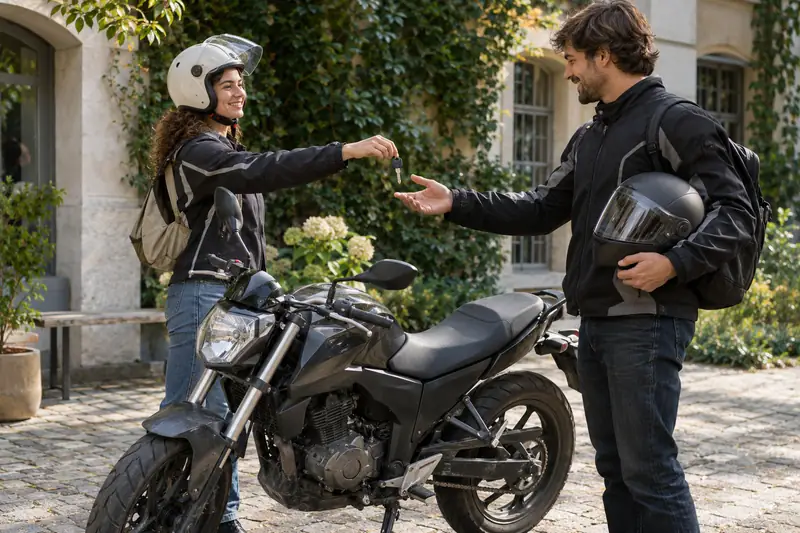
Motorcycle sharing is a service that lets a rider use a motorbike or scooter without owning it, in return for a payment based on time, distance or a subscription. The machine is booked through an app or a platform, unlocked on site and returned afterwards. It exists in two main forms: fleets run by a company, often with electric scooters in cities, and peer-to-peer platforms where private owners lend their motorbikes to approved riders. It is aimed at people who ride occasionally or want to try before buying.
Two ways to share a motorbike
The first model is the company fleet. An operator parks scooters or light motorbikes in a city, and members find the nearest one with an app, ride it, and leave it in a permitted area. Helmets are sometimes provided in a top box, though some operators expect you to bring your own or use a hygienic liner.
The second model is peer-to-peer. Owners list their bike with photos, availability and price, and approved riders send a booking request. This offers a wider choice, from small commuter bikes to touring machines, and often better prices for several days, but handover, mileage and fuel are agreed directly with the owner through the platform.
A third option, a monthly subscription to a bike, is available in some markets and bundles insurance and servicing in one payment.
Licence requirements and age limits
The licence needed depends on the power and type of the machine and on the country. In many places, a small scooter needs only a basic category, while larger motorbikes require a full motorcycle licence obtained through a test. Operators check your licence category when you register and refuse a booking if it does not match the vehicle.
- Have your licence ready before you create an account.
- Read the minimum age and the minimum experience required by the operator.
- Foreign licences may be accepted for visits, but check validity and category.
- Do not lend a booked bike to someone else: the insurance covers only the named member.
If you do not yet hold the right licence, a riding school can explain the options and costs of getting it.
Prices and what you pay for
Short city trips on shared scooters are generally billed by the minute, sometimes with a small unlocking fee, and day or week rates are offered for longer use. Peer-to-peer bikes are priced per day, with a mileage allowance and a deposit, which is returned if the bike comes back in the same condition.
Compare the full cost, not only the headline number. Check what is included: fuel or charging, helmet, insurance, roadside assistance and a second rider. Also check the excess you would pay after a fall or theft, since a motorcycle excess can be high.
For a rider who goes out only a few weekends per year, sharing usually costs less than buying, insuring, storing and servicing a motorbike. For daily commuters, a longer rental or ownership may be better.
Insurance, equipment and safety
Insurance rules are the most important point to understand. Operators generally include third-party liability and some damage cover in the price, with an excess. Peer-to-peer platforms usually provide a policy for the rental period, but its limits differ, so read the conditions before you book.
Safety equipment is not a detail on two wheels. A certified helmet is compulsory in most countries, and gloves, a protective jacket, long trousers and sturdy boots reduce injuries in a fall. In wet weather, grip is reduced, so allow longer braking distances.
Take a minute before riding to check the tyres, brakes, lights and mirrors, and report any problem through the app. If you are not comfortable on the machine, choose a smaller or lighter model instead of pushing yourself on your first outing.
Booking, unlocking and returning
The routine is simple once you have done it. Choose the machine, confirm the time and read the pick-up details. With fleet scooters, you scan a code or tap the screen to open the storage box and start the engine. With a private owner, you meet at the agreed place, inspect the bike together, take dated photos and sign or confirm a handover report.
At the end of the rental, return the machine to the agreed area, with the fuel or battery level required. Park on the side stand or centre stand, lock the steering where relevant and end the trip in the app so that billing stops.
Keep your photos and receipts until the deposit is released. If you are late, warn the owner or the operator right away, as late fees can be charged by the hour.
Where motorcycle sharing makes sense
It is practical for urban errands, for tourists who want to explore a coast or a mountain road for a day, and for people who cannot park a car in the centre. A scooter can also solve the last kilometres between a station and a business district.
It is helpful to people who dream of owning a motorbike and want to test different types first: a naked roadster, a trail bike, a touring machine or a small electric scooter. Renting several models over a season gives a more reliable idea of the right purchase than reading reviews.
Riders who travel abroad can also use peer-to-peer rentals to find a bike at the destination instead of paying to transport their own. Always check local traffic rules, speed limits, and whether the host country allows riding with the licence you hold.
Common mistakes to avoid
Beginners often underestimate how different a larger motorbike feels from a scooter, particularly the weight, the power delivery and the braking. Start gently and give yourself time to adapt. Others forget to check the opening hours of the pick-up place, or book a bike whose luggage space is too small for their trip.
Do not skip the photographs at handover. Without them, a pre-existing scratch can turn into a dispute. Do not ride without the proper equipment, even for a short trip, and never ride under the influence of alcohol or medication that affects your reactions.
Finally, read the cancellation policy. Rain or a change of plans can make a booking pointless, and conditions for free cancellation vary widely between platforms and private owners.
Costs of owning compared with sharing a motorbike
Owning a motorbike involves more than the purchase price. Insurance for riders is often expensive, especially for young or new riders, and there are also costs for registration, servicing, tyres, protective clothing, secure parking and a lock or alarm. A machine used only on sunny weekends can cost far more per ride than it seems.
Sharing turns most of these fixed costs into variable ones. You pay when you ride, and the owner or operator carries maintenance, storage and depreciation. The drawback is that popular models are booked early in summer and prices rise at peak times.
A sensible approach is to estimate how many days you ride in a year, then compare the total ownership cost with the rental cost for that number of days. Include the value of not having to repair or store the bike in winter.