
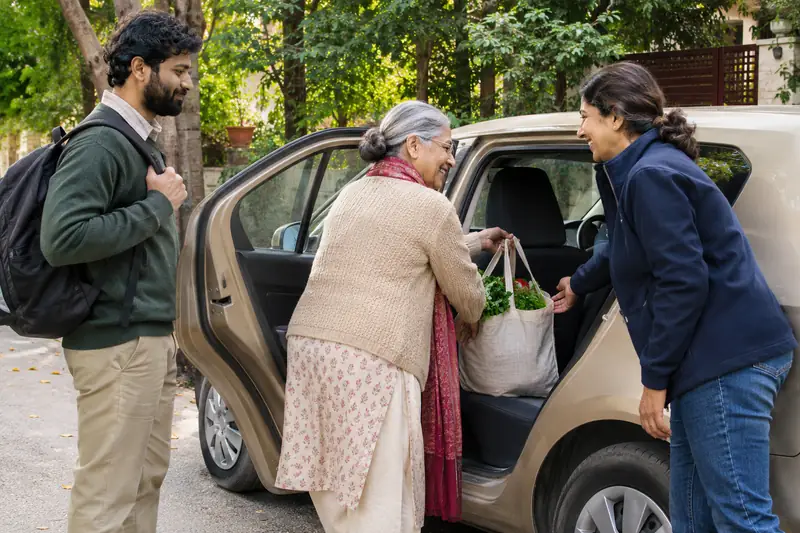
Free carpooling is a shared journey in which the driver asks passengers for no money at all, so everyone travels together at no charge. The driver is already making the trip and simply offers empty seats, often to friends, colleagues, neighbours or members of a club. Costs such as fuel and tolls are borne by the driver, or compensated through turn-taking, favours or goodwill. It is the simplest form of car sharing, based on trust and reciprocity rather than payment.
When free carpooling is truly free
A free ride means that no payment is requested or expected in exchange for the seat. That can happen in several ways. A parent drives other children to football practice and another parent takes the next week. A group of colleagues drive in rotation and each person pays only for the weeks they drive. A volunteer driver offers seats to fellow members of an association.
It is different from a low-cost ride, where the passenger shares the fuel. Some people prefer the free version because it avoids calculation and keeps the relationship informal, while others find a modest contribution more comfortable because it avoids a feeling of debt.
Neither approach is wrong. What matters is that all sides understand and agree on the terms before the trip begins.
Rotation and reciprocity
The most common free arrangement works through turn-taking. Each person drives on a set day, so over a month everyone spends the same number of journeys behind the wheel. No money is needed because the costs even out.
- Draw up a calendar and share it with the group.
- Agree a simple rule if someone cannot drive on their day, for example swapping with another person.
- Keep the group small enough so that the schedule is easy to manage.
- Choose cars of similar size and fuel consumption where possible, so that the exchange stays fair.
When one person has a much bigger or thirstier car, the group may decide that this person drives a little less often or that others occasionally contribute fuel.
Where to find a free lift
Free rides generally circulate within communities rather than through large commercial platforms. Employers may host a notice board or an intranet page. Universities and schools often have groups where students and parents offer seats. Sports clubs, religious communities, volunteer organisations and neighbourhood associations arrange shared transport for events.
Some apps and websites allow drivers to set the price at zero, and community groups on social networks exist for specific towns or routes. In these cases, take the same precautions as with any new contact: read the profile, check the identity and agree the meeting point in advance.
If you are travelling alone, tell someone you trust who the driver is, where you are going and when you expect to arrive. A free ride is still a journey with a stranger if you have never met the person before.
Safety and insurance
Motor insurance generally protects passengers carried without payment, and many policies treat unpaid lifts as ordinary use. Policies differ, though, so confirm with your insurer, particularly if you give lifts often or if the trip is related to work or to an organisation.
Free does not mean careless. Drivers should hold a valid licence, keep the car in good condition, respect speed limits and take breaks on long trips. Passengers should wear seat belts, avoid distracting the driver and speak up if they feel uncomfortable.
For regular groups, it is useful to agree on a few rules such as no alcohol before driving, no phone use at the wheel and the right of anyone to ask for a stop. These points seem obvious, yet stating them clearly helps everybody feel respected.
Costs hidden behind a free ride
Even when no money is asked, the journey has a cost. Fuel, tolls, wear on the tyres and brakes, servicing and parking are paid by the driver, who carries them voluntarily. A good passenger recognises this and finds other ways to show appreciation, such as offering coffee, helping to carry bags, being punctual or taking the next driving turn.
For long trips, it is often fair to offer to pay for tolls or a share of the fuel, even when the driver says it is unnecessary. A refusal is perfectly acceptable, but the offer shows respect.
In groups, a small fund for shared costs can be useful, but keep it simple. If the arrangement starts to resemble a business, with fixed prices and contracts, it is no longer a free ride and different rules can apply.
Common situations: school, clubs and events
Free carpooling is most visible in everyday community life. Parents share the school run in the morning and afternoon, saving time and reducing the number of cars near the school gate. Teams travel to away matches in a few cars. Choirs, associations and volunteers go to meetings together.
Events create temporary needs: weddings, festivals, funerals, trade fairs and sports tournaments. An organiser who sets up a simple message group with seats offered and requested can reduce parking problems and costs for guests.
In each case, the organiser should record the departure points, times and phone numbers, and make sure that every child or vulnerable passenger has an adult responsible for them. A little planning avoids confusion and allows more people to take part.
Limits and when to use a paid platform
The free model works best among people who know each other and travel regularly on the same route. For one-off long trips between cities, it can be hard to find a suitable driver without a platform, and informal arrangements leave little recourse if someone cancels at the last minute.
In that case, a platform that lets drivers ask for a contribution to costs may be more reliable, because the booking and the profile information bring accountability. The price is usually modest and covers part of the fuel and tolls.
Choose according to your need. For daily or weekly journeys within a trusted circle, free carpooling is often ideal. For occasional trips with unknown people, a structured service with profiles, ratings and payment protection may provide greater peace of mind.
A short checklist before the first trip
Before travelling with someone for the first time, take five minutes to cover the essentials. It avoids awkward surprises and shows that you take the arrangement seriously.
- Confirm the meeting point, the departure time and the destination address.
- Ask whether luggage, pets, child seats or bicycles are accepted.
- Exchange phone numbers so that you can warn each other of delays.
- Agree what happens if the journey must be cancelled.
- Check that the driver is comfortable with stops for rest or fuel.
On the day, arrive a few minutes early, keep your belongings tidy and thank the driver at the end. Good manners cost nothing and make it far more likely that the offer will be repeated.