
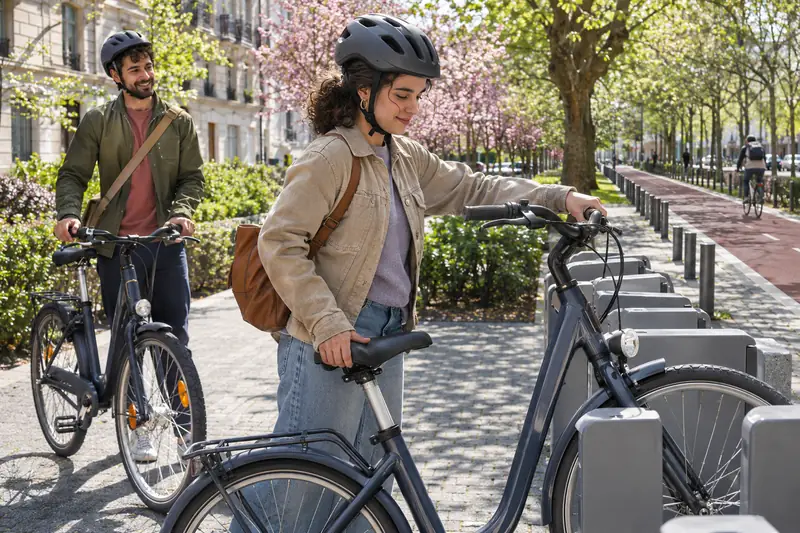
In France, bike sharing means using a bicycle without owning it, either from a docking station or free-floating scheme run by a city or company, or by renting a bike from another person. Most large cities offer self-service bikes available by the trip, the day or a yearly pass, and many now include electric models. You register through an app or a terminal, unlock the bike, ride, and return it according to the scheme's rules. Prices, areas and conditions differ from one city to another, so check the local operator before you travel.
Bike sharing in France: types of shared bikes
French cities offer several formulas, and the right one depends on your trip. Docking-station schemes let you take a bike from one station and return it to another. Free-floating schemes allow you to leave the bike inside a defined zone, usually using the app to lock it. Station-free hire by the day or week suits visitors, and long-term rental offers a bike for several months.
- Docking stations: reliable for regular short trips in the city centre.
- Free-floating bikes: flexible, but check the permitted parking areas.
- Electric assist bikes: useful for hills and longer distances.
- Cargo or folding bikes: offered by some local schemes.
Before choosing, look at the map in the app to see how dense the network is near your start and destination.
Ask yourself whether you need a bike for a quick hop or for a full day, because this changes the best formula.
How registration and unlocking work
Registration is almost always done on a phone. You create an account, add a payment card and sometimes confirm your identity. Some schemes ask for a deposit or a pre-authorisation on the card, which is released later according to their terms.
- Download the official app of the operator.
- Choose a pass: single trip, day, week or annual.
- Scan the code or enter the bike number to unlock it.
- Check brakes, tyres and lights before leaving.
- Lock the bike at the end and wait for confirmation in the app.
If a bike has a fault, report it in the app and take another one. This protects you from being charged for damage that was already present.
Prices and passes in practice
In France, bike sharing prices depend on the scheme. Many offer a free first period of each ride, then a small charge for the following minutes, with higher rates for electric bikes. Annual passes are typically cheaper per trip for regular users, and some local authorities offer reductions for students, jobseekers or low-income residents.
- Occasional pass: suits visitors and one-off trips.
- Subscription: better if you ride several times a week.
- Employer contribution: some employers reimburse part of the cost of a cycling pass.
Compare prices on the operator's official page, as rates change and are not the same in every town. Keep an eye on penalties for returning a bike outside a station or for exceeding a time limit.
Check also whether the pass covers several towns of the same metropolitan area, which can matter if you cross administrative borders on your commute.
Rules of the road for cyclists
Shared bikes follow the same road rules as private bikes. In France, you ride on the road or in cycle lanes, and you must respect traffic lights, priority rules and signs. Lights are required at night and when visibility is poor.
- Cycle lanes and tracks are widespread in the biggest cities.
- Pedestrian areas may have their own rules for cyclists, such as walking speed.
- Helmets are mandatory for children under twelve, whether passengers or riders, and recommended for everyone.
- Using a phone in your hand while riding is not allowed.
Take care near tram tracks and in wet conditions, because wheels can slip. Lock the bike properly after use even if the scheme offers cover for theft.
Peer-to-peer bike rental and sharing between individuals
Besides city schemes, some platforms let owners lend bikes to neighbours or travellers. This can be useful for specialised bikes, such as cargo bikes, electric mountain bikes or children's models, which are not found in public schemes.
- Check the owner's description, photos and reviews.
- Agree on pick-up, return, deposit and any damage rule in writing.
- Ask whether the bike is insured and what happens in case of theft.
- Test the brakes, gears and battery when you collect it.
Private owners may have different conditions from companies, so read the platform's terms about liability and payment. A small written note on the bike's condition at hand-over avoids disagreements.
Choosing between cities and regions
Offers change a lot across the country. Large cities such as Paris, Lyon, Lille, Bordeaux and Strasbourg have established networks, while small towns may run a few stations or a rental centre for long-term hire. Tourist areas often have rental shops that rent bikes by the day, including electric ones.
- In big cities, count on frequent stations and a dense network.
- In small towns, check whether a municipal rental service exists.
- In the countryside, bike rentals near stations or tourist offices are common.
If you travel by train, look at the local transport pass; some combine public transport and cycling in a single account.
Tourist offices can usually tell you which rental points are open in the low season.
Safety, insurance and liability
Operators usually include some basic insurance in their service, but conditions vary. You remain responsible for riding safely and for respecting the rules. Ask whether the scheme covers theft, damage or accidents, and what excess you may have to pay.
- Check your personal civil liability insurance, often included in home insurance.
- Report any accident to the operator promptly.
- Do not leave the bike unlocked or in an unauthorised area.
- Avoid carrying heavy loads or passengers unless the bike is designed for it.
Carry a small light and wear visible clothing in the evening. In case of a fault, stop and report it rather than riding a bike that feels unsafe.
Tips for a smooth ride
Start by testing the scheme with a short trip and learn how the bike unlocks and locks. Check the battery level on electric models, because a flat battery makes the bike heavier to ride.
- Check the app for free stations before you set out.
- Keep your phone charged and bring a mount if you use navigation.
- Take a photo of the bike when you return it, as proof.
- Avoid the busiest hours if you are new to city cycling.
Combining bike sharing with the train or tram often gives the best door-to-door journey. When you finish, look at your account history to confirm that the trip is closed and that the cost matches what you expected.
Bike sharing organisations in France
- Vélib' Métropole : The self-service bike scheme of Paris and surrounding towns, with mechanical and electric bikes.
- V'Lille : The shared bike service of the Lille metropolitan area, with long-term hire options.
- Vélo'v : The self-service bike network of Lyon and its metropolitan area, available by day or by subscription.
- Vélhop : A bike hire and sharing service in Strasbourg, with short and long-term rental.
- Donkey Republic : A bike sharing operator with app-based rentals in several French towns.
Further reading
- Fédération française des usagers de la bicyclette : The national federation of cycling user associations, with advice on safe and everyday cycling.