
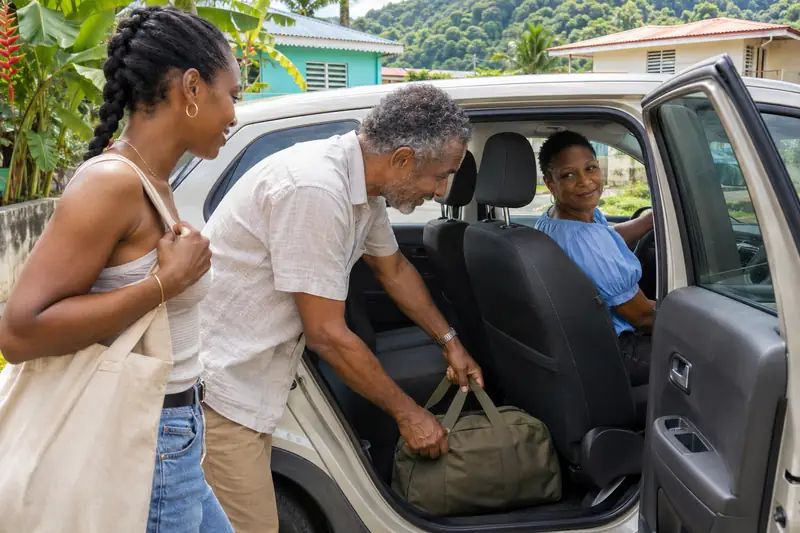
In Guadeloupe, carpooling is the sharing of a private car journey between a driver and passengers who travel the same way and divide the costs of fuel and parking. It is used mainly by daily commuters around Pointe-à-Pitre, Baie-Mahault and the Jarry industrial zone, and by students and families across Grande-Terre and Basse-Terre. Traffic is heavy at rush hour, and public transport does not serve every area, so shared rides are also an important complement for daily mobility on the archipelago.
Why carpooling is attractive in Guadeloupe
The archipelago has a road network built around a few busy hubs. Most jobs, shops and administrations are concentrated around the Pointe-à-Pitre and Baie-Mahault area, while many residents live in communes along the coasts or in the hills of Basse-Terre. The result is long queues on the main roads in the morning and evening, as thousands of workers head towards the same places.
Public transport exists, with urban and interurban buses, but timetables and coverage do not always match working hours, especially in outlying communes. At times of disruption, such as a bus strike, carpooling becomes one of the solutions mentioned by local media and authorities.
For households, sharing a car lowers fuel costs and parking expenses, and for employers it reduces the pressure on car parks near offices and business zones.
Local platforms and initiatives
Guadeloupe has seen several carpooling initiatives, including local platforms and national services that cover the territory. One local application, Dépozé, has been presented by the authorities as a tool for everyday journeys and events, and it has been promoted for festivals. Karos, a French operator, has also offered services in Guadeloupe for commuting.
Public employers, such as the administration, have extended carpooling to their staff, and the state's local departments have published documents on mobility and carpooling. These initiatives encourage employees to use shared vehicles and to coordinate through the apps.
Compare the services on coverage, ease of use, how they check profiles and whether they offer incentives or rewards. If you work for a large employer, ask whether it participates in a scheme, because matching colleagues is often easier than finding strangers.
Costs and fair sharing
Without tolls on most roads, the main costs are fuel and wear on the vehicle, plus parking in towns such as Pointe-à-Pitre. Fuel prices on the island are regulated, but the cost of living is high, so reducing even a modest expense is significant for many households.
A simple method is to divide the monthly fuel and parking costs by the number of regular occupants. Some groups rotate drivers weekly so that no money has to be exchanged. For irregular journeys, the platform's suggested price or a fixed amount per trip can be used.
Remember that the objective is cost sharing, not profit. Avoid asking for more than your real costs, and be open about how you calculate the contribution. A clear arrangement written in a message for the group helps prevent disagreements and keeps everyone comfortable.
Rules, insurance and responsibilities
French law applies in Guadeloupe. Motor insurance must cover the driver's liability, and it generally covers passengers. A driver who carpools often should inform the insurer, and keep documents such as the registration certificate, insurance certificate and technical inspection up to date.
Safety rules are strictly applied. Seat belts are compulsory for all passengers, children need suitable restraints, and driving after drinking alcohol is dangerous and punished. Speed limits and the ban on handheld phones also apply on the island.
- Stay alert on narrow roads in the hills and near the coasts.
- Avoid driving through flooded sections during heavy rain.
- Follow the instructions of the authorities during hurricane alerts.
A driver who offers rides must remember that the right to share costs does not extend to running a taxi business without authorisation.
Commuting around Pointe-à-Pitre and Jarry
Jarry, one of the largest business and industrial zones in the Caribbean French territories, draws thousands of workers every day. The access roads around Baie-Mahault, Pointe-à-Pitre and the Rivière Salée bridges are often congested. Employees of the same company, or of neighbouring ones, can share vehicles and save considerable time.
Organising a group is straightforward. Choose a meeting point near a main junction, agree a departure time and rotate the driver. A messaging group helps warn others of delays. Employers can support the group by offering reserved parking, flexible start times or a shared notice board.
If you live in Basse-Terre and work in Jarry, a shared ride can make a long commute more bearable. The driver can keep their route, and passengers can rest, read or prepare for the day.
Events, festivals and the beach
Carpooling is not only for work. During carnival, concerts, football matches and popular festivals, parking is limited and roads around the venue are crowded. Organisers and local media have encouraged people to use shared rides to reach events, and some platforms have been promoted for exactly this purpose.
Beachgoers also share cars at weekends and in summer, when the most popular sites have limited parking. A group of friends who take one car instead of three eases the pressure on roads and car parks and shares the cost of fuel.
For evening events, designate a driver who will not drink alcohol, and agree on a meeting point and time for the return trip. A clear plan allows everyone to enjoy the event, and makes the journey home safer for all.
Moving between Grande-Terre and Basse-Terre
The two main islands are joined by a few bridges and roads around Pointe-à-Pitre, which can become bottlenecks. Some residents live on one island and work on the other, and others travel regularly for studies or family reasons. For them, sharing a car for part of the journey is especially useful.
Plan journeys carefully by checking road works and traffic information before leaving. Allow extra time during rain and at the busiest hours. Passengers should be on time, since delays affect the rest of the trip, and drivers should communicate any change in route or schedule.
For travel to other islands of the archipelago, such as Marie-Galante, the Saintes or La Désirade, you need to plan ferry times and parking at the port. Carpooling to the ferry terminal can save a car parking space and some stress.
Good practice for lasting groups
The most successful groups are built on reliability. Everyone should respect the departure time, signal absences and treat the car with care. A clear rule about waiting time, such as five minutes, protects the group from delays.
Discuss practical matters at the start: who sits where, whether music or conversation is welcome, and how food and drinks are handled. Talk about holidays, school vacations and peak weeks, and how the group will adapt.
Keep a spare option, such as the bus, a taxi or a friend, for days when the carpool cannot operate. Review the arrangement from time to time and invite new members when seats are free. A friendly, organised group can last for years and make the daily commute a more pleasant moment.
Carpooling organisations in Guadeloupe
- Dépozé : Local carpooling application presented for everyday journeys and event travel in Guadeloupe.
- Karos : French carpooling operator offering daily commuting services, including in Guadeloupe.
- Mobicoop : French cooperative carpooling platform that can be used for shared rides across French territories.
Further reading
- DEAL Guadeloupe : State department for environment, planning and housing, with documents on mobility and carpooling.