
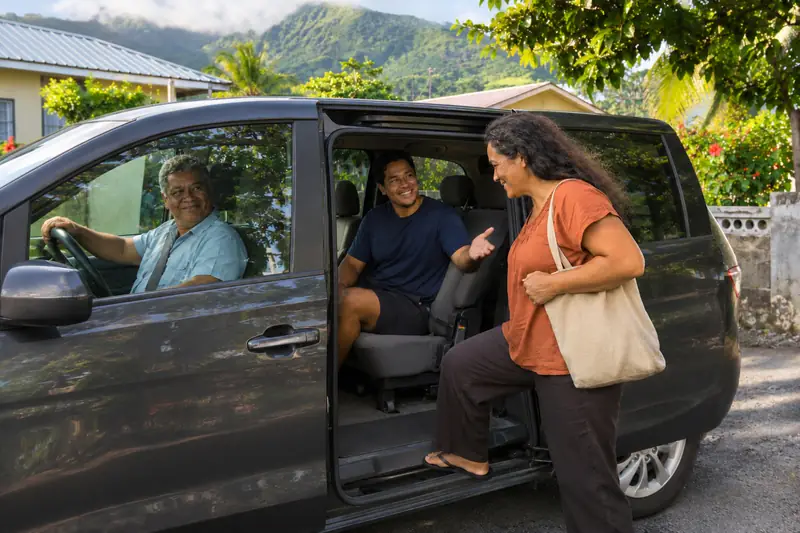
In Tahiti, carpooling is the practice of sharing a private car journey, so that a driver and passengers who travel in the same direction divide the costs of fuel and parking. It is used chiefly by commuters travelling to and from Papeete along the coastal road, where traffic jams are frequent at rush hour. The island has one main road that circles most of the coast, and public transport is limited in the evening, so shared rides can reduce costs, stress and the number of cars in the capital.
Carpooling in Tahiti and the island geography
Tahiti is the main island of French Polynesia and is shaped like a figure eight, with a mountainous interior and a road that follows the coast. Most jobs and services are concentrated in Papeete and the neighbouring communes of Faa'a, Pirae, Arue and Punaauia. Many residents live to the east or west of the capital, which means that thousands of people travel along the same few roads each day.
Because the road network offers few alternatives, a single accident or a heavy rain shower can create long delays. Traffic is particularly dense in the morning towards Papeete and in the late afternoon in the opposite direction. This makes carpooling an obvious idea: fewer cars on the same road means smoother traffic.
For residents, sharing a ride also helps to deal with the high cost of living on the island, where fuel, vehicles and parking are expensive.
Public initiatives and platforms
The authorities of French Polynesia have shown interest in carpooling. The department in charge of land transport has published information on the subject and launched a call for projects to create a carpooling platform. Such initiatives aim to offer residents a simple way to find rides, and to reduce traffic and emissions.
Applications and groups also exist, including national platforms such as Mobicoop, which allow free publication of rides, and local groups on social networks. Employers and large organisations sometimes arrange rides among staff.
As offers evolve, check what is currently available and active on your route. Prefer services that verify profiles and let you contact the other person through the application before you meet. When no platform is active in your area, a workplace group or a neighbours' message group is often the quickest option.
Costs and contributions
The costs of a journey in Tahiti are mainly fuel, parking in central Papeete and wear on the vehicle. Prices in French Polynesia are expressed in Pacific francs, and fuel is relatively expensive, so even a short commute has a significant cost over a month.
A fair contribution is the total cost of the round trip, divided among all occupants, including the driver. For regular rides, many groups agree on a monthly sum or share the driving in rotation. If the driver goes out of the way to collect a passenger, a small supplement can be reasonable.
Carpooling is meant to share expenses, not to create income. Contributions that go beyond the real costs on a regular basis may be treated as a paid transport activity, which falls under different rules. Keep amounts modest, explain how you calculate them and settle payments on a regular schedule.
Insurance, rules and safety
Motor insurance is compulsory, and a standard policy covers passengers in the vehicle. Drivers who share rides regularly should inform their insurer and confirm that cost sharing is covered. Keep the vehicle documents, insurance certificate and inspection papers in the car.
Seat belts are mandatory, children should travel in suitable seats, and drink driving is dangerous and punished. Speed limits are low on much of the island, and respecting them is important, especially in built-up areas and near schools.
- Check the identity of the other person before the first trip.
- Agree on a clear meeting point, such as a car park or a shop.
- Slow down during heavy rain, when the road may be slippery.
- Avoid driving when tired, especially after a long working day.
Passengers should be punctual, and drivers should communicate any delay as soon as they can.
Commuting to Papeete from the west and east coasts
Commuters from Punaauia, Paea and Faa'a face the same bottlenecks each morning when they head towards the capital, and those from Mahina, Arue and Pirae experience similar delays from the east. The airport area and the main roundabouts are common points of congestion.
Colleagues who work in the same building or district are the natural carpool partners. A meeting point at a shopping centre or a petrol station with plenty of parking is easy to find, and many groups use a simple message thread to coordinate. Some employers allow flexible hours to help employees avoid the worst traffic.
When possible, choose a departure time that avoids the heaviest peaks, even by fifteen minutes. It may reduce the journey time significantly, and a group that is flexible can adjust the schedule to find the best compromise.
Public buses, Le Truck and combinations
Tahiti has a public bus system, often called Le Truck in its traditional form, serving Papeete and the coastal communes. It is a popular and inexpensive way to travel, but timetables are limited at night and on Sundays, and some routes do not reach small residential areas.
Carpooling can complement the bus. A driver may bring a passenger to a bus stop on the main road, or a group may share a vehicle to a hub where public transport is more frequent. For late shifts, carpooling is often the only practical option after the last buses.
Plan alternatives for days when the group cannot travel. Check bus times in advance and keep some small change or the means of payment accepted. Combining modes of transport makes daily life easier and reduces dependence on a single solution.
Leisure, surf and island trips
Tahiti attracts residents and visitors for its beaches, waterfalls, hiking trails and surf spots, such as Teahupo'o on the southern coast. Roads to the peninsula of Taiarapu and to the south can be long, and parking at popular spots is limited. Sharing the car with friends reduces the number of vehicles at crowded places and divides the cost of fuel.
Visitors who rent a car can also invite others to join an excursion, though they should check the rental agreement for rules on additional drivers and insurance. For events in Papeete, such as concerts or cultural festivals, a shared ride to a car park on the edge of the centre avoids searching for a space.
Always check the weather, as heavy rain can cause rivers to rise, and avoid crossing flooded roads. Safety comes before the schedule.
Starting a group and making it last
Begin with a few colleagues or neighbours who live along the same road and travel at similar hours. Share the contact details, agree the meeting point and set rules for waiting time and payments. A small group is easier to manage and builds trust.
Review the arrangement after a few weeks. If the schedule needs adjusting, discuss it openly and propose changes. If someone leaves, invite another person to join so that the cost remains well shared.
Keep a backup plan, such as a bus or a taxi, for days when the carpool cannot run. A reliable group saves money, reduces stress and improves everyone's daily routine. Over time, it can also strengthen friendships among colleagues and neighbours, and help the island move towards less congested and more sustainable roads.
Carpooling and mobility organisations in Tahiti
- Direction des transports terrestres : Polynesian government department for land transport, which has published information on carpooling and a call for a carpooling platform.
- Mobicoop : French cooperative platform for commission-free carpooling, usable by drivers and passengers for shared journeys.
- Hello Covoit' : Mobile carpooling application that helps drivers and passengers share journeys and costs.
Further reading
- Direction des transports terrestres : Official information on land transport and sustainable mobility in French Polynesia.