
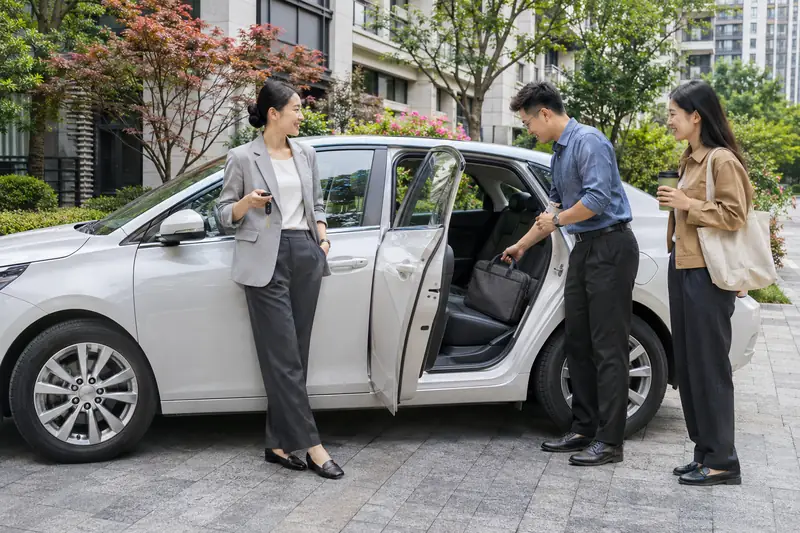
In China, carpooling, commonly called pinche, means sharing a car journey with other people who travel in the same direction, either on a long intercity trip or on a daily commute. Most arrangements are made through mobile apps, which match drivers and passengers, display the share of costs and keep a record of the journey. Authorities set limits to separate genuine cost-sharing from unlicensed taxi activity, so rules on the number of daily trips and on pricing are an important feature of the system.
What pinche means and how it differs from a taxi
The word pinche literally refers to putting something together, and in everyday speech it covers sharing a taxi, a ride-hailing car or a private vehicle. The version closest to carpooling is the shared trip in a private car whose owner is already making the journey and offers spare seats for a contribution. It is different from a taxi or an ordinary ride-hailing service because the driver is not supposed to operate as a full-time transport business.
- Intercity pinche covers trips between neighbouring cities, such as those in the Yangtze River Delta or the Pearl River Delta.
- Commuter pinche links suburbs with business districts.
- Holiday pinche spikes before the Spring Festival, when millions travel home.
Understanding the distinction helps travellers choose the right service and set realistic expectations on price.
Apps and platforms that organise shared rides
In China, almost every shared journey is booked on a smartphone. The big mobility platforms offer a dedicated carpool or hitchhike function, matching a driver's planned route with passengers along the way. Navigation and super-app ecosystems also integrate ride sharing, so travellers can use the same account for payment and identity verification.
Foreign visitors should know that most services require a Chinese mobile number, a local payment wallet and often a real-name registration, which can be a barrier for short stays. Some international travellers prefer to arrange a standard taxi or a pre-booked car instead. Residents, by contrast, find that the apps display a driver's profile, vehicle and completed trips, and that payments flow through the platform, which reduces cash disputes.
Carpooling in China and the legal framework
Rules governing private cars that carry paying passengers are strict. Authorities distinguish between genuine cost-sharing among people travelling anyway and the unlicensed operation of a taxi. After serious safety incidents some years ago, the main platforms tightened their hitchhike services, introduced stricter checks on drivers and limited the number of trips a driver can publish each day.
- Drivers must hold a valid licence and registration and often pass identity checks.
- Fares are designed to cover costs, not to generate a salary.
- Platforms may restrict trips by time of day or by route to protect passengers.
Rules differ by city and change over time, so it is sensible to read the conditions inside the app and, where in doubt, consult the local transport authority.
Costs and how payment works
Passengers usually see a price before they confirm, calculated by the platform from distance and expected expenses. For intercity trips the amount is typically lower than a coach or train ticket on short routes, though it can be higher during peak holiday dates. Payment is made through a mobile wallet linked to the app, and receipts are stored in the account.
- Check whether tolls on expressways are included in the displayed price.
- Keep the payment inside the app so that the platform can help in the event of a dispute.
- Be aware that cancelling at the last minute can lead to a fee or a lower rating.
Because the cost is shared, a trip with several passengers can be markedly cheaper per person than a private ride-hailing journey over the same distance.
Intercity trips and holiday travel
China has an extensive high-speed rail network, and for many city pairs the train is faster than any car. Shared car journeys remain attractive where stations are far from the origin or destination, where schedules are inconvenient or where tickets are sold out around public holidays. Drivers who return to their home town for the Spring Festival often offer seats to colleagues and friends.
The main practical challenge in the busy periods is congestion on expressways, which can add many hours to a journey. Travellers should leave early, carry water and snacks and agree where to stop. Drivers must also remember that fatigue is a real hazard on long trips, so rotating drivers, when more than one passenger holds a licence, is a wise precaution.
Safety habits for passengers and drivers
Platform tools exist to protect users, and it is wise to use them fully. Check that the vehicle number plate and the driver's photo match the details shown in the app, and share the trip with a trusted contact using the built-in function. Sitting in the rear seat and wearing a belt is the standard recommendation for passengers travelling alone.
- Do not accept a ride arranged outside the app.
- Keep your phone charged and your location sharing active.
- Use the emergency button or call the local emergency number if you feel unsafe.
Drivers also benefit from these safeguards, since a verified record of the trip shows who was in the car and when. Both sides should rate the experience honestly to help the community.
Commuting and company carpools in large cities
Cities such as Beijing, Shanghai, Guangzhou and Shenzhen face heavy congestion and restrictions on new licence plates, which makes car ownership expensive. Some residents share their car with colleagues who live nearby, and some employers organise group travel from distant suburbs. In these cases, the monthly cost of fuel, parking and tolls is divided between several people.
Where local rules limit driving on certain days according to the plate number, shared arrangements can be organised around the days a car is allowed. Parking near business districts is scarce and costly, so a group of three or four people can save a noticeable amount every month. A written plan for pick-up points and waiting times prevents frustration among regular travellers.
Tips for visitors and foreign residents
Visitors who read little Chinese often find a standard taxi or a pre-arranged car easier than a shared car. Residents with a local phone number and payment wallet have more options. Translation tools help to message a driver, and showing the destination in Chinese characters on the screen avoids misunderstanding.
- Carry your passport, since some operations need identity verification.
- Confirm the pick-up point on the map before leaving the building.
- Learn a few basic phrases for greeting and thanking the driver.
Chinese drivers are often glad to chat, and a friendly atmosphere is part of a good trip. Respecting local etiquette, such as not slamming the door and keeping the car clean, makes a positive impression and encourages good ratings.
Carpooling and ride-sharing platforms in China
- DiDi : China's largest mobility platform, whose Hitch service connects private drivers with passengers on shared routes.
- Hellobike : Mobility company offering bike sharing and a hitchhike service for shared car journeys.
- Amap (Gaode) : Navigation app that includes ride-hailing and shared trip options inside the same interface.
Further reading
- ITDP : International non-profit working on sustainable urban transport, with research on Chinese cities.