
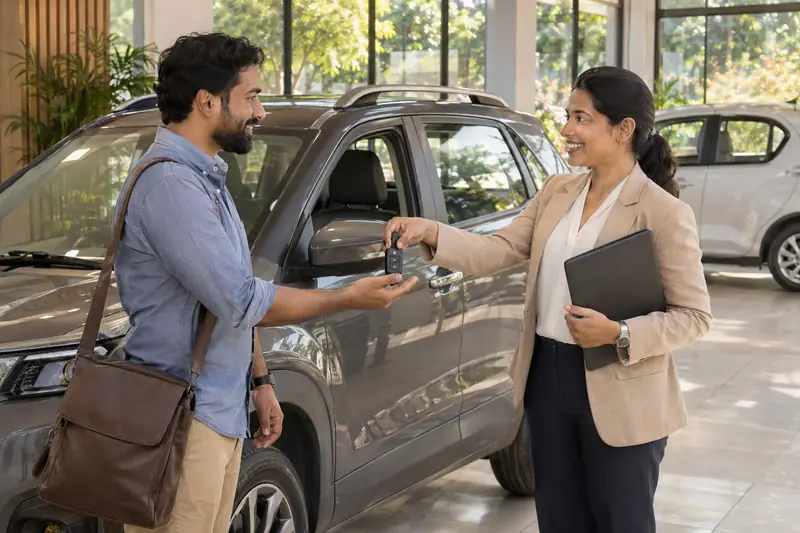
In Berlin, a monthly car subscription is a rental in which you pay one monthly fee for a car that already includes insurance, vehicle tax, servicing and assistance. Germans call it an Auto-Abo. You do not buy the car and you do not sign a loan, and contracts are usually short, from one month to about two years. In a city with dense public transport, many residents want a car only for particular needs, such as trips to Brandenburg, family visits or work appointments, and the flexible formula fits that pattern well.
Why a car subscription appeals to Berliners
Berlin is a city where many households live without a car. The U-Bahn, S-Bahn, trams and buses reach most districts, and bicycles are widely used. Yet there are situations where a car is useful: moving house, a family trip to the lakes, visiting relatives in another region or working in places that trains reach poorly.
A monthly subscription avoids the large cost of buying a car that stands idle for most of the week. It also avoids the administrative burden of insurance, vehicle tax and inspections, which the provider handles. For people who move to the capital for a period, such as students, researchers, start-up employees or diplomats, the short commitment is a clear advantage.
On the other hand, a car you use rarely can be more expensive than renting by the day, so count your real needs first.
What the monthly fee includes
A usual contract includes the car, liability and comprehensive insurance, vehicle tax, the regular inspection, wear repairs, tyres and assistance. Some providers also include delivery and a set of winter tyres.
- Not included: fuel or electricity, parking, tolls and fines.
- Limited: a monthly or yearly mileage allowance, with extra kilometres billed.
- Variable: the excess in case of damage, which can be reduced against a fee.
- Optional: an extra driver, a trailer hitch or a roof box.
Look at how the provider handles trips abroad. Berliners often drive to Poland or the Czech Republic, and the contract may restrict countries or require a notice.
Parking and the cost of keeping a car in Berlin
Parking is the most important local cost. Large parts of the inner city have paid parking, and residents can apply for a parking permit for their district, which gives a right to park in their zone but not a guaranteed space. Underground car parks and garages are available, but rents can be high in popular areas.
A subscription does not include a permit. To apply, you normally need the vehicle registration papers, and because the car belongs to the provider, you may need a document confirming that you are the regular user. Ask the company whether it provides such a letter before you sign.
If you live in a district with pressure on street parking, include the price of a garage in your budget, because it may be as large as part of the subscription fee.
What a monthly car subscription in Berlin costs
Prices depend on the car, the term and the mileage. A compact petrol or hybrid car costs less than an electric estate, and a shorter term costs more per month than a longer one. Offers with a large initial payment may show a low monthly figure, so check the total.
When you compare, use the same duration, the same yearly distance and the same excess in every quotation. Add your own costs for fuel, parking and any charging. Then compare the result with the cost of car sharing and day rentals, which may be cheaper if you drive fewer than a few days per month.
Providers check your credit through the German credit bureau, so a clean record helps. Newcomers without a German history can often be accepted with a deposit.
Environmental zone, charging and city traffic
Central Berlin lies inside an environmental zone, which requires a green sticker on the windscreen. Cars from subscription fleets normally have it, and you should confirm that it is displayed. Traffic is heavy on the city ring and on the main roads at peak hours, and roadworks are frequent, so allow extra time.
Electric cars are common in offers. Public charging points are spread across the city, and some are on the street, while others are in car parks or shopping centres. If you rent a flat without a charging point, ask whether your building or a nearby garage allows charging, as relying only on public points can be time-consuming.
Ask which charging card is provided with the car and how roaming costs are billed.
Documents, licence and eligibility
You need an identity document, a driving licence and a bank account, and often a registration certificate from the city. Licences from European countries are valid in Germany. Licences from other countries can generally be used for six months after you become resident, and then they must be exchanged or you must pass the German tests, depending on the country.
The minimum age is often twenty-one, and drivers under twenty-five may pay a supplement. The provider runs a credit check and may ask for a deposit.
Complete the online form with care and upload clear documents. Missing or unreadable files are the most frequent reason for a delay, and a car can take a few days to be delivered after approval.
Ending the contract and returning the car
The main attraction is flexibility, but conditions vary. Check the minimum term, the notice period and the fee for ending early. Some providers let you swap to another model after a few months.
When you return the car, a report records its state. Take dated photos of all sides, the wheels, the interior and the mileage, both at collection and at return. Keep the key set, the service book and any accessories supplied. Normal wear is accepted, and the provider bills dents, tyre damage and heavy stains according to a table.
Fines for parking or speeding reach the provider first. It names you as the driver and may add an administrative charge, so keep an eye on your post and email.
Alternatives to compare in Berlin
Berlin has several car sharing operators, from free-floating services to station-based cooperatives, and a dense rental market. These can be cheaper if you use a car for a few hours at a time. A public transport pass with occasional car sharing is the cheapest answer for many residents.
A subscription becomes interesting when you drive often enough that the per-hour fees would add up, or when you want a car available at any time without the cost of ownership. Do a calculation over your intended period and compare at least three offers before you sign.
Monthly car subscription providers for Berlin
- Sixt+ : A subscription service of the Sixt group with insurance and servicing in the monthly fee.
- FINN : A German digital provider of monthly car subscriptions with delivery to your door.
- Carvolution : An online provider of subscriptions with several terms and models.
Further reading
- ADAC : Germany's largest motoring club, with guides on car costs, insurance and breakdown help.