
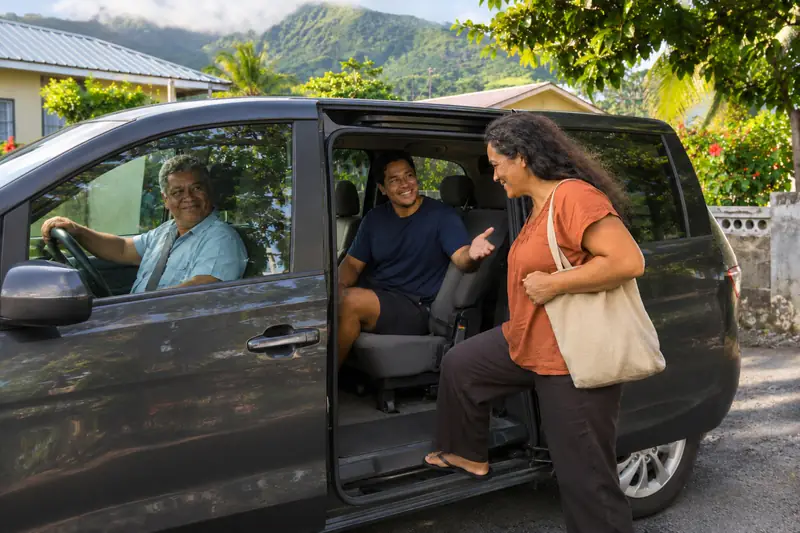
In Thailand, carpooling means that people who travel the same way, such as colleagues commuting into Bangkok or friends driving to Chiang Mai, ride in one car and share the fuel, tolls and parking. It is common among families, students and workers, particularly during Songkran and other holidays. Thai rules strictly limit the carriage of paying passengers in ordinary private cars, so a carpool should stay a genuine arrangement among acquaintances, with no commercial element, no advertising of seats and no profit.
Why carpooling in Thailand suits a car-dependent country
Car use has grown rapidly in Thailand, and cities such as Bangkok experience heavy congestion, with long periods spent in traffic every day. Outside the capital, public transport can be sparse, and many people depend on cars or motorbikes. Sharing a vehicle among household members, neighbours and colleagues reduces the cost of fuel, expressway tolls and parking, which can be high in business districts.
- Office workers on the same suburban corridor.
- University students travelling at the end of term.
- Families returning to their home provinces for festivals.
These examples show that carpooling in Thailand is mostly a private, informal arrangement, based on trust and personal connection rather than on public advertising.
The legal context: private cars and paying passengers
Thai law distinguishes between private vehicles, which use white licence plates, and public transport vehicles, such as taxis, which use different plates and a licence. A private car that carries passengers for payment, outside a lawful arrangement, can result in fines, and enforcement has at times targeted unlicensed ride services. Ride-hailing apps operate in a regulated or semi-regulated environment that has evolved over the years.
For that reason, a carpool should be about people who know each other sharing costs for a trip that the driver would be making anyway. Avoid offering rides to the general public for money, and do not post seats on commercial platforms as if you were a taxi driver. If you wish to run a service professionally, you would need the appropriate licence. When in doubt, ask the Department of Land Transport or a local legal adviser.
Finding co-travellers in Thailand
Workplaces and universities are the best places to start. Many companies have staff groups where employees post their commuting route and look for partners. Neighbourhood groups and condominium notice boards can also help. For occasional long trips, friends of friends are the usual source of travel companions.
- Choose people you can contact easily and who are reliable.
- Agree on a meeting place that is safe and easy to reach.
- Discuss the amount to share before leaving.
For safety, send details of the trip to a relative. If you are a foreign resident or visitor, make sure you understand local etiquette, such as polite greetings and respectful behaviour, which can make a big difference in how a trip is perceived by others.
Sharing expressway tolls, fuel and parking
Bangkok and the surrounding provinces have a network of expressways with tolls, which are now frequently paid with an electronic pass. Fuel, tolls and parking are the three costs a pool should share. The easiest approach is to add them up for the month, divide by the number of people and settle at the end of the period by bank transfer or mobile payment.
For one-off long journeys, calculate the distance and estimate fuel from the car's consumption, then add tolls. Be transparent about the figure. A driver should not seek more than the real cost, and passengers should avoid arguing about small differences. Mobile banking and QR code payments are extremely common in Thailand, which makes it easy to pay precisely and keep a record of the amount sent.
Songkran and other peak travel periods
The Thai New Year festival of Songkran in mid-April sends millions of people home, and road traffic increases dramatically. Authorities usually announce safety campaigns and check points, and the days around the holiday have been known for a high number of road accidents. Sharing a car with family can reduce the number of vehicles on the road, but fatigue and alcohol must be taken seriously.
- Leave early in the morning or late in the evening to avoid the worst jams.
- Rotate drivers every couple of hours where possible.
- Avoid alcohol before driving, whatever the festive atmosphere.
Other peak times include the New Year period and long weekends. Plan your route with real-time traffic information and keep a margin for delays, particularly on roads towards the north and north-east.
Alternatives for intercity and urban journeys
Thailand offers many alternatives to the private car. Long-distance buses connect most provinces, and the State Railway runs trains from Bangkok to the north, north-east and south, including sleeper services. Domestic flights are inexpensive on certain routes. In Bangkok, the elevated and underground rail systems, buses and river boats cover much of the central area.
Ride-hailing and taxi apps give on-demand options for short trips, with fares shown before you start. A shared private car is useful when the schedule is awkward, the destination is far from stations or the group has luggage. For a single traveller, public transport is often cheaper and less tiring; for three or four people, sharing a car can be the most economical choice for a long trip. Compare the total cost and the time before deciding.
Safety and driving conditions
Thailand has a high rate of road traffic deaths, in large part due to motorcycles, speeding and drink driving. In a shared car, seat belts matter for all occupants, including those in the rear. Drivers should obey speed limits, which are enforced with cameras, and avoid using the phone while driving. During the rainy season, sudden downpours reduce visibility and make roads slippery.
- Check tyres, brakes and lights before long trips.
- Take a break every two hours.
- Keep a car insurance certificate and licence in the vehicle.
If you drive as a foreigner, an international driving permit or a Thai licence is needed. Accidents involving foreigners can lead to long procedures, so valid insurance is essential and should be checked before you accept passengers.
Etiquette and good habits
Politeness and calm are valued in Thai society. Arrive on time, greet others with a smile and avoid raising your voice, even in a traffic jam. Remove shoes if you are visiting someone's home on the way, and avoid conversations that could cause offence, such as comments about the monarchy, which is protected by law.
Inside the car, keep things tidy, respect the driver's preferences about food and air conditioning and offer to share the cost of refreshments. If you plan to stop at temples or markets, discuss it in advance. A relaxed and respectful atmosphere will make the journey pleasant, and word of your good manners will spread within the community, making it easy to find other people to travel with in the future.
Transport services and operators in Thailand
- State Railway of Thailand : National railway running passenger trains from Bangkok to many provinces, including sleeper services.
- BTS Skytrain : Elevated rail network in Bangkok useful for combining with a shared car to the city edge.
- Grab Thailand : Ride-hailing and delivery platform operating in Thai cities.
Further reading
- Tourism Authority of Thailand : Practical information for travellers moving around the country.