
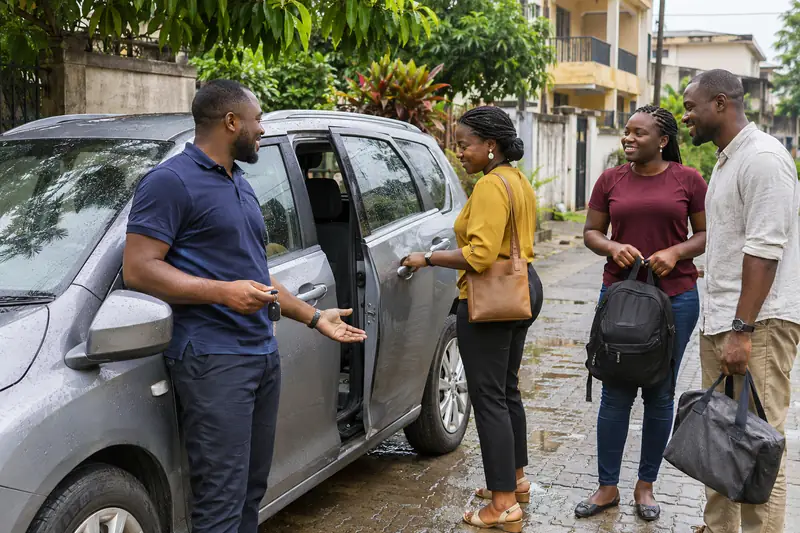
In Cameroon, carpooling is an arrangement in which a driver already travelling by car, for example from Douala to Yaoundé, accepts passengers heading to the same place and asks them to pay a share of the fuel and any road costs. It grows mostly through personal contacts, workplaces and messaging groups. The driver is not a professional carrier, and the contribution should reflect real expenses rather than profit. Agreeing the amount, the departure time and the luggage beforehand is what keeps these trips smooth and trustworthy.
Carpooling in Cameroon: the Douala–Yaoundé axis and other busy routes
The road between the economic capital and the political capital is the heart of intercity movement in the country. Thousands of people make the trip each week for business, administration and family reasons, and a private car with free seats is a natural fit. Other well-used routes lead from Douala towards Bafoussam, Limbe and Kribi, and from Yaoundé towards Bertoua and Ebolowa.
- Business travellers use shared cars to reach meetings without waiting for a coach to fill.
- Families coordinate lifts for weddings, funerals and festivals.
- Students travel between university towns and their home regions.
Departures early in the morning are popular because they avoid the heat and the heaviest traffic. Journey times vary with traffic at the entrances of the big cities and with the state of the road, so it is wise to plan generous margins.
How seats are found and booked
Because no single national platform dominates, people rely on tools they already use. Drivers post their route in neighbourhood or professional groups, and passengers answer with a phone call. Church communities, alumni networks and company staff groups are particularly active for regular trips.
It is a good idea to exchange basic details before agreeing: full name, phone number, the car model and the plate. The passenger should know where exactly the car will wait, for instance a petrol station or a roundabout, and the driver should know how much luggage to expect. Confirm the plan the evening before and again on the morning of departure. Payment is usually settled either in cash at the start or by mobile money, which many Cameroonians use daily for transfers.
Fair contributions: fuel, tolls and car wear
A shared trip should cost the driver less than travelling alone, not turn into a business. The simplest method is to add up the fuel needed for the whole route, include road tolls on the sections where they apply, and share the total equally among everyone in the car. Drivers sometimes add a small amount for oil or tyres on very long journeys.
- Ask the driver how he or she calculated the amount.
- Pay in the currency agreed, the CFA franc, and keep small notes ready.
- Do not renegotiate on the road; settle everything before leaving.
When fuel prices change, drivers and regular passengers can adjust their contribution together. Transparent figures make a trusting relationship and encourage people to keep sharing rides.
Choosing coaches or a shared car for intercity trips
Travel agencies running scheduled coaches connect the main cities every day, and they remain the most common way to cover long distances. They offer ticketing, fixed departures and luggage handling. Their disadvantage is that departure sometimes depends on how quickly the coach fills, and the terminal may be far from the traveller's final address.
A shared private car offers more control: the driver can pick up passengers close to home and drop them nearer to their destination. However, it has no company behind it, so the traveller carries more responsibility for checking who is driving. People who do not know any driver personally are usually better advised to use a licensed coach operator, while regular travellers with trusted contacts can appreciate the flexibility of a shared car.
Road safety and personal precautions
Safety is the first question for anyone considering a lift. Road conditions, night driving and heavy trucks require alert driving, and vehicles should be in sound mechanical condition before leaving. A responsible driver does not overload the car, avoids overtaking in poor visibility and stops when tired.
- Send the plate number and the driver's name to someone you trust.
- Keep your identity card within reach for checkpoints.
- Avoid travelling at night on unlit roads.
- Wear a seat belt even for short distances.
Passengers who feel uneasy should say so and, if necessary, leave at the next safe town. No saving is worth a risk to personal safety, and a polite refusal costs nothing.
Commuting and carpooling inside the big cities
In Douala and Yaoundé, urban traffic is a daily constraint. Many residents depend on shared taxis, minibuses and motorbike taxis, but office workers who own a car can reduce costs by sharing it with colleagues living nearby. Taking turns to drive spreads the expense of fuel and parking and offers an easier journey than crowded public options.
For such arrangements to last, the group needs fixed meeting points, a clear time limit for waiting and a plan if someone is absent. Companies can encourage the habit by allowing flexible starting times when traffic is heavy. In a city where rush hours can multiply travel time, an organised carpool is not only cheaper but often more predictable than improvising each morning.
Responsibilities, insurance and legal points
Cameroon requires motor insurance for vehicles, and drivers should ensure their policy is valid before carrying others. It is worth asking the insurer how passengers are covered when a private car is used for a shared trip, since conditions differ between companies. Drivers must also carry their licence, registration and technical inspection documents, as checks can be frequent.
- Do not charge more than the real cost of the trip.
- Refuse to carry more passengers than the number of seats.
- Keep a written record of what was agreed, even a simple message.
These points matter because an informal favour can quickly become a dispute if an accident or a breakdown occurs. Honest agreements and valid papers protect everybody, and they show passengers that the driver takes the responsibility seriously. A driver who refuses an overloaded departure earns respect, and a passenger who asks to see the documents is simply being prudent.
Making shared journeys work over time
The best carpooling relationships are repeated ones. Drivers who offer the same route every week gradually build a circle of regular passengers who know the departure time and the habits of the car. This reduces the need for new introductions and increases trust on both sides.
Small gestures help: arriving a few minutes early, helping with luggage, keeping the car clean and sharing the cost of a refreshment stop. If a problem arises, discuss it calmly and directly instead of complaining to others. Over time, a reliable network of shared journeys can cut travel costs significantly, bring people together and reduce the number of half-empty cars on the road between Cameroon's busiest cities.
Transport companies and mobility services in Cameroon
- Garanti Express : Intercity coach company with departures between major Cameroonian cities, a common alternative to a shared car.
- Finexs Voyages : Passenger transport agency running scheduled coaches on several national routes.
- Touristique Express : Coach operator linking Douala, Yaoundé and other cities with regular departures.
Further reading
- World Bank in Cameroon : Information on transport and urban development programmes in the country.