
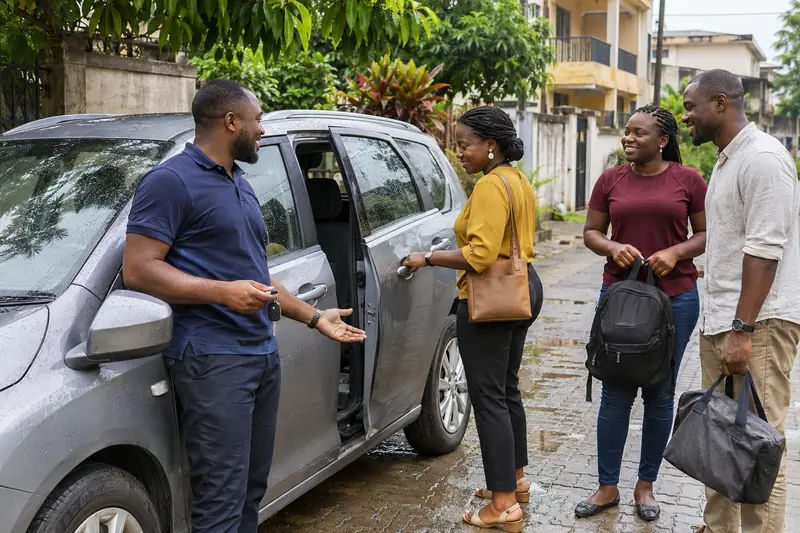
In Ivory Coast, carpooling means that a driver who is going to a given destination, such as Yamoussoukro, Bouaké or San-Pédro, takes passengers who share the same route and ask them to contribute to fuel and tolls. It exists mostly through personal contacts, workplaces and social groups, alongside well-developed collective transport such as minibuses and shared taxis. The idea is to share costs, not to earn income. Agreeing on price, timing and luggage before departure keeps the trip comfortable and safe.
Why carpooling in Ivory Coast makes sense
The country has one of the better road networks in West Africa, with a motorway linking Abidjan to Yamoussoukro and continuing towards the centre. Many professionals travel regularly between the economic capital and cities in the interior, and a car with empty seats is an obvious opportunity. Sharing the trip reduces the fuel bill, which is the largest cost for most drivers.
- Employees of companies with offices in several cities travel together on Monday mornings and Friday evenings.
- Families gather for festivals, funerals and the end-of-year holidays.
- Students go home to the interior at the end of term.
The motorway toll, where it applies, is another expense that shared trips divide neatly between occupants.
Busy corridors and typical journeys
The Abidjan–Yamoussoukro axis is the busiest intercity route, and it is also the starting point for journeys to Bouaké, Korhogo and the north. Another important axis follows the coast towards San-Pédro, the country's second port, while roads towards Man and Daloa serve the west. Each has its own rhythm: northbound lines fill up on Friday evenings, and southbound ones on Sunday afternoons.
Travel times depend on traffic around Abidjan, where bridges and entrances to the city can be saturated at rush hour. A driver who leaves before dawn can save hours. Passengers should be ready at the meeting point on time, since the first delay in the city has consequences for the entire day.
How to find a ride or fill your seats
There is no single national carpooling system, so most people start with their own network. Colleagues, neighbours and alumni associations are the first sources. Social media groups for specific routes also exist, where drivers post departure details and passengers respond. In these spaces, it is wise to ask for references and to meet the driver in a public place before agreeing to a long journey.
- State your departure time, meeting point and number of free seats clearly.
- Ask the passenger how much luggage they have.
- Confirm the contribution in writing before leaving.
Applications for ride hailing are widespread in Abidjan, but they serve city journeys, not the shared intercity model described here.
How much to contribute and how to pay
The reference amount is the cost of fuel and tolls for the trip, divided by the number of people. Drivers sometimes add a margin for general wear of the vehicle, but it should stay modest, otherwise the arrangement becomes a business. Passengers who compare the figure with the price of a coach ticket can judge whether it is reasonable.
Payment is commonly made in cash in CFA francs, either before departure or on arrival. Mobile money services, which are used by a large part of the population, make it simple to settle the amount with a transfer and keep a record. If the driver pays the toll at the barrier, passengers should reimburse their share at once rather than at the end. Clear numbers and a prompt payment are the basis of a good reputation as a passenger.
Alternatives: coaches, minibuses and shared taxis
Passengers have several other choices. Intercity coach companies run departures from major stations, with tickets and luggage handling. In Abidjan, public buses and boats across the lagoon complement the network, while minibuses known as gbaka and shared taxis called woro-woro carry people within and between districts at low prices.
A private shared car does not replace these services; it complements them. It is useful when the travel time of a coach does not fit, when the destination is off the main route or when a group of colleagues prefers to travel together. Because commercial transport is regulated, a driver who carries paying passengers regularly may need the appropriate permits, which is why private arrangements must stay limited to genuine cost-sharing.
Road safety and personal precautions
Speeding and fatigue are major risks on long roads, even good ones. A responsible driver rests after several hours, respects speed limits and avoids overtaking on blind curves. Vehicles should be serviced before long trips, and the spare tyre and warning triangle must be on board.
- Wear a seat belt in every seat.
- Do not accept a driver who has been drinking.
- Tell a relative the plate number and the expected arrival time.
- Keep identity documents accessible at checkpoints.
Passengers should feel free to speak up if the driving feels dangerous. If the driver does not change, the safest decision is to ask to be dropped at the next town, however inconvenient that may be.
Commuting in Abidjan and other cities
Abidjan is a large and congested metropolis, where bridges between districts such as Cocody, Yopougon and Plateau slow down travel at rush hour. Employees who own a car sometimes offer seats to colleagues on the same road, taking turns to drive. This cuts fuel and parking costs and shortens the wait for crowded public transport.
Group arrangements function best when they are specific: a fixed pick-up point, a waiting limit of five minutes and a way to notify others about absences. If a bridge or road is closed, one member of the group can propose another route. Such a pool also helps people who live far from the city and have to leave very early; they know that they will not travel alone.
Rights, duties and good practice
Drivers need a valid licence, registration and insurance. They should check with their insurer how passengers are covered when a private vehicle is used for a shared journey. Passengers are responsible for their own belongings and for paying the agreed share promptly.
Keep the atmosphere pleasant: respect the driver's rules on food, music and smoking, and thank him or her at the end. If a conflict arises, deal with it politely and in private. Many drivers and passengers form lasting friendships through repeated journeys, and in a country where social ties matter, a good reputation as a reliable traveller is worth more than a few saved coins. A driver who has earned that reputation will find that seats fill within hours of a message, and a passenger with good references will always find a place when the holiday rush begins.
Transport companies and mobility services in Ivory Coast
- UTB : Intercity coach company with departures from Abidjan to many towns of the interior, widely used as an alternative to private lifts.
- SOTRA : Public transport company of Abidjan operating buses and lagoon boats in the metropolitan area.
- Yango : Ride-hailing app active in Abidjan for urban journeys, a complement to intercity shared trips.
Further reading
- World Bank in Côte d'Ivoire : Background on infrastructure and transport in the country.