
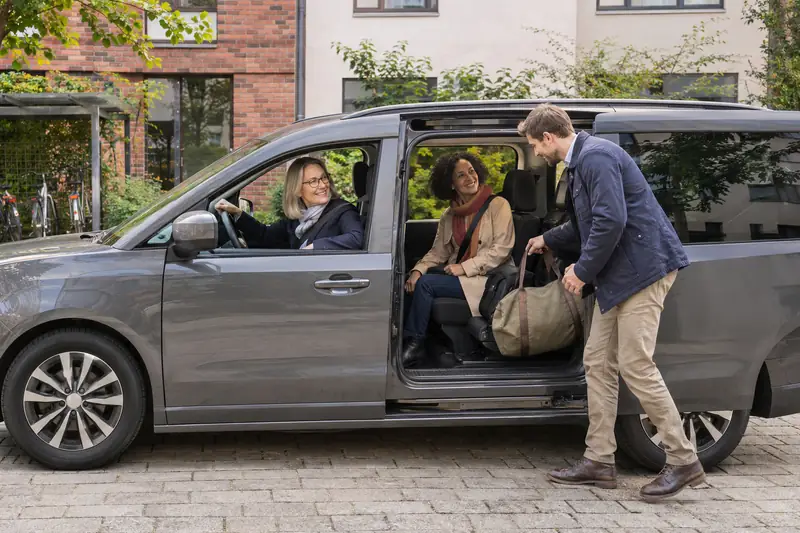
In Germany, carpooling is the sharing of a private car journey between a driver and one or more passengers who contribute to the costs. Germans call it a Fahrgemeinschaft when colleagues or neighbours travel together regularly, and a Mitfahrgelegenheit when a ride is offered to a passenger for a single trip. It is used for commuting, long-distance travel between cities and trips to festivals or football matches, and it is easy to organise through platforms, workplace groups and community boards.
Carpooling in Germany has a long tradition
Germany has a long history of organised ride sharing. Before apps existed, local Mitfahrzentralen, or ride-sharing agencies, matched drivers and passengers by phone or in an office, and student notice boards carried handwritten offers. Today the same idea runs on websites and smartphones, but the vocabulary has survived: you still hear that someone is looking for a Mitfahrgelegenheit.
The country's size and its central position in Europe make it a natural place for the practice. Distances between cities such as Hamburg, Berlin, Munich, Frankfurt and Cologne are long, train tickets can be expensive when booked late, and a large share of the population lives in regions where regional trains are infrequent. A shared car often offers a flexible and affordable alternative.
Commuters, students and travellers across borders all use it, and the culture of sharing is well accepted.
Platforms and where to look
International services such as BlaBlaCar operate widely in Germany and cover the main intercity routes. There are also German websites that focus on Mitfahrgelegenheiten, and some regional or company platforms for commuters. Public transport associations and large employers sometimes run their own schemes.
Universities remain a hub. Student unions and campus portals often list rides for journeys home at the weekend or at the end of the semester. Social networks host groups for particular routes, for instance from a university town to a family home in another region.
When you compare services, look at the way profiles are verified, whether the platform charges a fee to the passenger, and how cancellations are handled. For regular journeys, choose tools that allow repeated bookings and notifications.
Costs and cost sharing
Contributions should reflect the costs of the journey, mainly fuel. The Autobahn network has no general toll for passenger cars, so the main variable cost is petrol or diesel, plus wear on the car. Platforms propose a price per seat based on the distance and typical consumption, and some cap the amount so that the driver cannot earn a profit.
On a long trip, a seat is often cheaper than a train fare, particularly when booked on the day. For regular commutes, groups either rotate the driver or agree a monthly sum. If a driver goes out of the way to collect someone, a small supplement can be reasonable.
As in other countries, the principle is that carpooling is not a business. Charging more than the costs and offering rides regularly for money can bring the activity under passenger transport regulations that require a licence.
Tax and employer support for commuters
German commuters can often claim a flat-rate deduction for the distance between home and work in their tax return, and this applies to people who share a car as well. In a Fahrgemeinschaft, each member can generally claim the deduction for their own journey, independently of who drives, according to the tax rules in force. Because the rules can change, check the current position with the tax office or a tax adviser.
Some employers support commuters with parking priority for carpoolers, internal ride boards, or mobility budgets. Regional transport associations may also offer apps and information on combining carpooling with trains or buses.
Ask your human resources department what exists in your company. Even a simple notice board in the canteen can start a successful group.
Speed, Autobahn and winter driving
German motorways are famous for sections without a fixed speed limit, though many stretches have limits and a recommended speed applies elsewhere. Drivers who carry passengers should drive in a way that suits traffic and weather, not the maximum speed possible. Passengers have the right to ask the driver to slow down if they feel unsafe.
In winter, tyres suited to winter conditions are required by law when there is ice, snow or slush. Drivers should check their tyres before the cold season and carry a scraper and warning triangle. Many roads in the Alps, the Harz and the Black Forest need extra care.
Plan departure times with traffic in mind. Weekends before holidays and Friday afternoons bring heavy congestion on routes towards the Alps and the coasts, and leaving early often saves hours.
Environmental zones and city access
Many German cities have low-emission zones where only vehicles with the appropriate sticker may enter. If you are carpooling into a city, the driver needs the right sticker on the windscreen and must verify access rules for the destination. Visitors from abroad should check whether their vehicles are permitted and how to register if needed.
Parking in city centres is often paid and limited, so many carpoolers meet at a park-and-ride facility and continue by tram, bus or metro. This also shortens the journey in heavy traffic. Meeting points at railway stations are common, but check the exact location, since large stations have several exits.
Regional public transport tickets valid across the country may also make a hybrid trip attractive: a shared car to a station followed by a train for the city part.
Safety and insurance
The compulsory liability insurance of the vehicle covers passengers. Drivers who regularly give lifts should inform their insurer and keep the vehicle in good order, with valid inspection. German law requires seat belts for all occupants and child restraints for children.
- Check the profile and reviews of the other person.
- Confirm name and car registration before getting in.
- Share your route with a friend.
- Agree on rest stops for long journeys.
- Do not drive tired or after drinking alcohol.
If an accident happens, secure the scene, call emergency services and the police when necessary, and exchange insurance details with those involved. Report the incident to your insurer and the platform.
Practical tips for a smooth ride
Punctuality is highly valued in Germany, and carpoolers are no exception. Arrive at the meeting point a few minutes early and warn the driver by message if you are late. Drivers who wait too long may leave, and that is considered acceptable.
Be precise about luggage. A boot for four people fills quickly, and a skis or a bicycle may not fit without prior arrangement. Say whether you travel with a pet or need a child seat. Pay the agreed contribution at the start or the end of the journey, according to the platform's rules.
Finally, remember that politeness and clarity go a long way. A short greeting, respect for quiet hours and a thank you at the end create a friendly atmosphere and increase the chance that drivers offer more rides in the future.
Carpooling organisations in Germany
- BlaBlaCar Germany : International carpooling platform with many daily intercity journeys across Germany and to neighbouring countries.
- Fahrgemeinschaft.de : German website for finding and offering rides, used for both single journeys and regular commutes.
- Mifaz : Long-established German platform for Mitfahrgelegenheiten and shared rides between cities.
Further reading
- ADAC : Germany's largest motoring club, with advice on driving, insurance, winter equipment and mobility.