
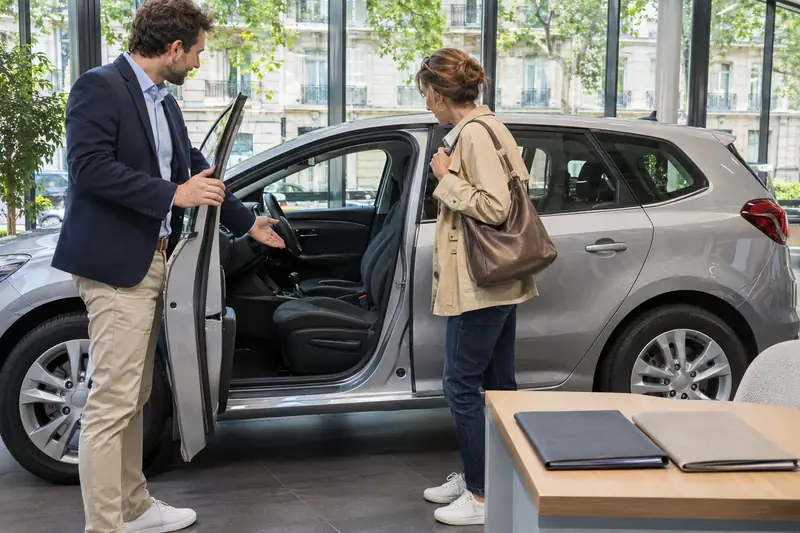
In Spain, a monthly car subscription is a flexible rental under which you pay a single monthly fee for a car that comes with insurance, maintenance and road tax. Unlike a traditional multi-year contract, it usually asks for a short minimum term, a modest deposit and a notice period that you can cancel with. Spaniards often call it suscripción de coche. It is popular with young drivers, foreign residents, remote workers and families that want to try a model, such as an electric or hybrid car, before taking a long-term decision.
How a monthly car subscription is arranged in Spain
The process is mostly online. You choose the model, the length of the contract and the kilometres per month, then upload your identity document and driving licence and pay the first instalment and the deposit by card. The company confirms the order, registers you as the user and arranges delivery to your home, a dealership or a collection point.
The provider stays the owner and handles the registration with the traffic authority, the municipal circulation tax and the technical inspection known as ITV. You carry the insurance documents in the glove box and call the assistance line if anything goes wrong.
Delivery times vary with stock. New models can take several weeks, while cars already in the fleet may be available in a few days. Ask for a written delivery date before you cancel any other arrangement.
What the monthly fee covers
The fee commonly includes comprehensive insurance, scheduled servicing, tyres and assistance, plus the municipal tax and the ITV. Some providers include a replacement car during long repairs. Fuel, electricity, parking, tolls on motorways and fines are paid by you.
- Check the insurance excess, which can be high for young or new drivers.
- Check whether a second driver is allowed and what it costs.
- Check the monthly kilometres, since extra distance is billed at a fixed price.
- Check whether the car may leave Spain, for example to Portugal or France.
In the islands, a transfer by sea may be needed to take the car to another island, so ask whether the contract allows it.
What a monthly car subscription in Spain costs
Monthly prices rise with the size of the car, the mileage and the novelty of the model. A short term costs more per month than a long one. Because Spanish prices are normally quoted with value added tax for private customers and without it for companies, read carefully which one appears in an advertisement.
The deposit is often equal to one or two payments and is returned after the car has been checked. Some providers replace it with a payment guarantee by card. Add the cost of your fuel, your parking and your tolls to see the true monthly budget.
Compare with a normal renting contract, which can show a lower monthly figure but tie you for three or four years, and with a purchase loan, which creates debt and ownership.
Requirements for foreign residents and newcomers
A European licence is valid in Spain. Licences from some other countries can be used for a limited time after you become resident, and then they must be exchanged or you must pass the Spanish tests, depending on agreements between countries. Ask the provider what it accepts before you apply.
You usually need an identity card or passport, a foreigner identity number for non-Europeans, proof of address and a bank card. Some companies request payslips or a bank statement, while others rely on the deposit and the card. A very recent arrival without a local bank account may find it easier to use a card from the previous country.
Young drivers under twenty-five often pay a supplement or face a higher excess.
Low emission zones and environmental labels
Spanish cities with more than fifty thousand inhabitants must have low emission zones, and many restrict access according to the environmental label of the car. Madrid, Barcelona and Valencia apply their own rules, with fines for those who enter without the right label.
When you choose a car, ask which label it has. Electric and plug-in hybrid cars usually receive the best labels and enjoy easier access and sometimes cheaper parking, while older diesel cars may be limited. Subscriptions normally use recent vehicles, so the risk is lower than with an old second-hand car.
Always check the municipal rules for the place where you live and work, since the details change from one city to another.
Comparing a subscription, renting and purchase
A subscription is the most flexible and often the most expensive per month. Renting is cheaper per month but needs a longer promise. A purchase gives ownership but also the burden of depreciation, repairs, insurance and the municipal tax.
Choose a subscription if you need a car for less than two years, if you are unsure about the model, or if you do not want to deal with administration. Choose renting if you know you will keep the car for several years. Choose a purchase if you drive a lot and for a long time.
Whichever route you pick, ask for the final price in writing and calculate the total over the period you plan to keep the car, not only the first month.
Returning the car and avoiding extra charges
At the end of the term, you return the car with its documents, keys and a similar fuel or charge level. An inspection compares the state of the car with the report made at delivery. Normal wear is accepted, while body damage, burns, stains and missing parts are billed.
Take dated photos at delivery and at return, and keep every service receipt. If you wish to stop earlier, read the early termination clause, because some companies ask for a part of the remaining instalments while others only require notice. If you receive a traffic fine, the company will identify you as the driver and may add an administrative fee, so pay attention to notices sent by post or email.
Electric cars and charging in Spain
Many providers highlight electric and hybrid models, because a subscription removes the fear of buying a technology that changes quickly. If you consider one, ask where you will charge. Owners of a parking space in a community building have the legal right in many cases to request a charging point, but approval and installation take time, so do not assume it will be ready on the day of delivery.
Public charging networks are growing, especially along main motorways and in large cities. Ask the company which charging card or app comes with the car and whether charging at public points is billed separately. Check the real range in winter and with air conditioning on in summer, since both reduce the distance you can drive on one charge.
Monthly car subscription providers for Spain
Further reading
- RACE : A Spanish motoring club that publishes advice on cars, insurance and roadside assistance.