
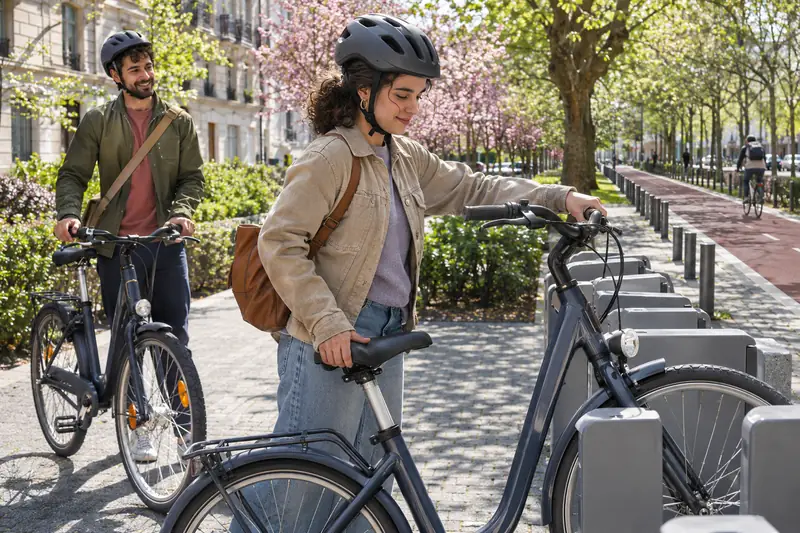
In Belgium, bike sharing lets you use a bicycle for a short trip, a day or a longer period without buying one, through docking-station schemes, station-based hire at railway stations, app-based rental or peer-to-peer lending. Brussels, Antwerp, Ghent, Leuven and many smaller towns have services, and some include electric bikes. You usually register online, pay by card and follow the operator's rules for locking and returning the bike. Conditions and prices vary by region and operator, so always check the latest details before you ride.
Bike sharing in Belgium: the main ways to share a bike
Belgium has a mix of systems rather than a single national network. In Brussels, a station-based service operates across the city. Many railway stations offer a subscription-based hire that lets you collect a bike after your train journey. Other towns run local schemes, and several companies offer app-based rentals or longer subscriptions that include maintenance.
- Station-based urban schemes for short trips.
- Railway station bikes for the last part of a journey.
- Long-term subscription bikes with servicing included.
- Peer-to-peer lending between neighbours or travellers.
Use the operator's map to check the nearest stations before you choose, because the density of the network is not the same everywhere, especially outside the biggest cities.
Registering and paying
Registration is generally done on a website or an app. You will need a valid email address, a payment method and often a phone number. Some services ask for a deposit on the payment card, while others charge only for the trips taken.
- Choose between a day pass, a week pass or an annual subscription.
- Check whether the operator offers reduced rates for students or local residents.
- Read the conditions on lost, damaged or stolen bikes.
In Belgium, bike sharing is also encouraged by employers through mobility budgets and bike allowances, so ask your employer whether part of the cost of a subscription may be reimbursed. Keep your invoices in case you need to claim them.
Check the cancellation rules of annual passes before you pay, particularly if you may move to another region.
Shared bikes and the railway
Combining a train with a bike is popular in Belgium. A rail-station service lets you collect a bike at the destination station and return it there or at another station of the network, with conditions depending on the offer.
- Check whether you need a subscription or can pay per use.
- Look at the opening hours of the stations and the number of bikes.
- Ask whether the bike may be returned at another station.
This is practical for commuting to a business park or university that is a few kilometres from the station. For leisure trips, you can also bring your own folding bike on many trains, although rules and supplements apply, so check them with the railway operator before you travel.
Remember that peak hours at big stations can mean fewer bikes available, so arrive a little earlier.
Road rules and cycling infrastructure
Cyclists in Belgium follow the highway code. Cycle paths, shared lanes and cycle streets exist in many towns, especially in Flanders, which has a dense network of cycle routes. Where a cycle path is marked, you usually must use it.
- Lights are required at night and in poor visibility.
- Use hand signals when turning.
- Watch out for tram rails and cobblestones, which can be slippery.
- Helmets are not compulsory for adult cyclists but are recommended.
In cities, pay attention to car doors opening and to vehicles turning right. Belgium has several shared-space zones where cyclists, pedestrians and cars mix, so reduce your speed there.
Cycling at night requires working lights, so check the bike's lamps before you leave the station.
Brussels, Flanders and Wallonia compared
The regions have different transport policies, and so the quality of bike sharing differs. Brussels has a station-based network with a growing number of bike lanes. Flanders offers many cycle routes and a strong cycling culture, with operators serving towns of all sizes. Wallonia has more varied terrain, which makes electric bikes especially attractive.
- Cities: frequent stations and subscriptions that give access to several towns.
- Flemish towns: easy cycling and often extensive route networks.
- Walloon towns: fewer stations, but growing tourist and local rental points.
If you plan an excursion, look for local tourist offices that rent bikes, as they know the best routes and can advise on the terrain.
Borrowing or renting from private owners
Private sharing is useful for particular bikes, such as cargo bikes for the school run or electric bikes for a weekend. Platforms and neighbourhood groups put owners and borrowers in touch.
- Agree on the dates, the price and the deposit beforehand.
- Ask for a short written note about the bike's condition.
- Check that the owner has the right insurance and tell them how you plan to use the bike.
- Return it clean and with the battery charged.
Remember that a bike lent between individuals is not covered by an operator's service guarantee. If it breaks, ask who pays for repairs before you ride away.
Safety, theft and insurance
Theft is a risk in Belgian cities, so use the lock provided and park in busy, well-lit places. Operators often state their own rules about reporting theft, and some require a police report.
- Report any theft or accident to the operator without delay.
- Check your family liability policy, which often covers damage you cause to others.
- Photograph the bike at the start and the end of the trip.
- Do not lend a shared bike to someone else unless the terms allow it.
Avoid leaving the bike where it blocks pavements or entrances. Cities can remove badly parked bikes, and the operator may pass the cost on to you.
Getting the best from bike sharing
Try a short ride first, check the app's map and keep a second option for the return trip in case the station is full. Plan the route with a cycling-friendly map, because the shortest route is not always the safest.
- Look for passes that include several towns or the railway.
- Use electric bikes for hills or longer rides.
- Check your account after each ride to confirm the amount charged.
- Keep a waterproof layer in the bag, as the weather changes quickly.
If you use shared bikes often, compare the cost of an annual pass with a personal bike, including maintenance and parking. For many people in town, sharing is cheaper and simpler.
Try different operators for a week each if you are unsure; the experience can differ more than the prices suggest.
Bike sharing organisations in Belgium
- Villo! : The self-service bike network of the Brussels region, with stations across the city.
- Blue-bike : A shared bike service at Belgian railway stations and in some towns, for the last part of a journey.
- Swapfiets : A subscription service that provides a bike with repairs included, available in several Belgian cities.
- Donkey Republic : An app-based bike rental operator that works with Belgian towns and hotels.
- Pro Velo : A Brussels organisation offering bike rental, training and advice for everyday cyclists.
Further reading
- Fietsersbond : A Belgian cyclists' association that provides information on cycling safety and routes.