
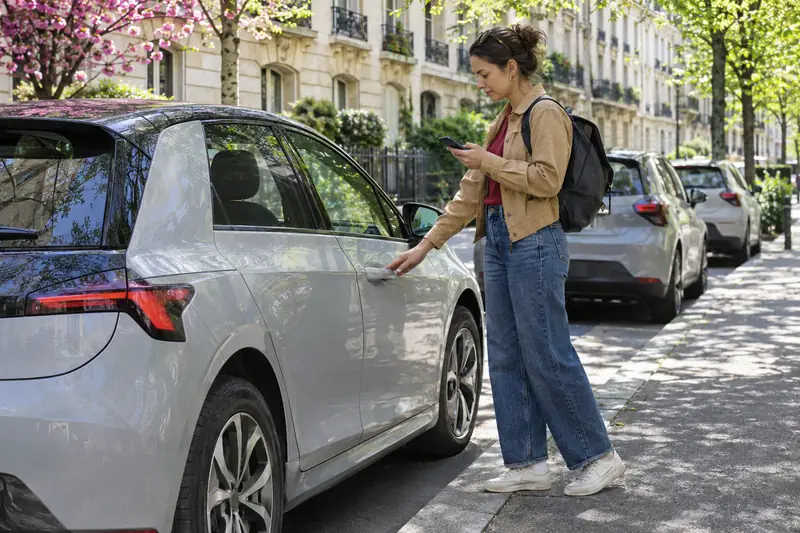
In France, car sharing, known as autopartage, is a self-service system in which several people use the same fleet of cars by booking them when needed. It is run by a company, a cooperative or a local authority and offers an alternative to buying a private vehicle. Members pay for the time or distance they drive, and the operator takes care of insurance, maintenance and cleaning. Cars are usually reserved through an app and opened with a smartphone or a member card.
How autopartage is organised in France
French autopartage developed first in large cities, where parking is costly and public transport is dense, and it has since spread to mid-sized towns. Operators may be private companies, cooperatives owned partly by their users, or services created by transport networks and councils as part of mobility policy.
Two main layouts exist. In the round-trip model, every car has a fixed parking bay and must be returned there. In the free-floating model, cars can be picked up and left anywhere in a defined urban zone. A third approach, between individuals, relies on owners who lend their vehicles through a platform.
Each layout answers a different need. Round-trip suits planned outings of several hours, while one-way models fit quick errands across town.
Joining and booking a car
The sign-up routine is similar from one operator to another. You create an account, provide identity and licence details, add a bank card and accept the contract terms. French operators generally require a licence held for a minimum period, and may ask newer drivers for an extra deposit or higher excess.
- Choose the pick-up location, date and duration in the app.
- Pick the car type: small city car, estate, electric model or van.
- Open the car with your phone or card at the start of the booking.
- Check the condition and note any damage before leaving.
- Return the car to the right place with enough fuel or charge.
Foreign licences are often accepted for a limited time, but you should confirm this with the operator before you travel.
Prices and what is included
Tariffs differ widely, so avoid relying on a single figure. Operators generally use a combination of a registration fee or subscription and a usage charge by hour, day or kilometre. Insurance, assistance and in many cases fuel are included, which removes several costs that private owners face separately.
Look at the small print on kilometre allowances, because long journeys can become expensive once the included distance is used up. Check also the penalties for late returns, the cost of cleaning in case of heavy soiling, and the excess that applies after an accident.
A fair comparison is made over a month or a year. If you drive only a few hours per week, shared cars can cost less than a purchased one once you add the loan, parking, servicing and tax. If you drive daily, owning or long-term rental may come out cheaper.
Where car sharing is available in France
Paris and its region have the densest offer, with several operators and many stations, but autopartage is also found in Lyon, Marseille, Bordeaux, Lille, Strasbourg, Nantes and other cities, often in association with the local public transport pass. Smaller towns and rural communities sometimes launch local schemes with a handful of cars, relying on associations or residents' cooperatives.
Availability changes over time as operators open or close stations, so check the live map in the app instead of relying on printed lists. Residents of large apartment buildings may also find cars parked in their own car park, offered through the building manager or social landlord.
Visitors can use many services too, as long as they can register with a valid licence and a payment card accepted by the operator.
Rules for parking, fuel and charging
Parking rules are central to a good experience. In a round-trip system you return the car to its own bay, which is reserved for the scheme. In free-floating systems, you must park legally within the zone and outside the restricted spaces listed in the app, such as delivery bays or areas with a temporary ban.
For fuel, most cars carry a card in the glove box. If the tank falls below a set level, the next user will appreciate a refill, and some operators reward members who do it. Electric cars should be plugged into a charge point at the end of the trip if the battery is low.
Fines issued during your booking are your responsibility. The operator identifies the driver and may add an administrative fee when forwarding the notice to you.
Electric cars and new mobility habits
Many fleets now include electric cars, which suits short urban journeys. A member can try an electric vehicle without buying one, learn how range and charging work, and decide later whether to switch. Fleets are also integrated into local mobility apps, so that one account can combine the bus, tram, bike and car.
Some residents use autopartage together with a bicycle or an annual public transport pass, and call a car only for the trips that other modes cannot handle well. This mixed approach is common in dense urban areas, where owning a car often means paying for a parking space that is barely used.
If you are curious, start with a short, low-risk trip to learn the app, the unlocking process and the return procedure before you rely on the service for something important.
Insurance and incidents
The operator's insurance normally covers third-party liability and damage to the car, subject to an excess that you pay in the event of a claim. Some services offer a reduction of this excess for an additional fee, which can be useful for new drivers.
If an accident occurs, stop in a safe place, switch on the hazard lights and call emergency services if anyone is hurt. Complete the European accident report with the other party if there is one, and contact the operator's assistance line shown in the app. Take photographs of the scene.
Breakdowns and flat batteries are usually handled by assistance included in the service, but you should still keep the receipts for any urgent expense, in case a refund is possible.
When autopartage is a smart choice
The approach works best for people who use a car fewer than a few times a week and who live close to a station or inside an operating zone. It frees households from fixed costs and gives access to different vehicles depending on the task, such as a van for moving or an electric car for a city trip.
It is less convenient for long holidays, early-morning departures when cars might not be available, or families who need fixed equipment such as child seats, although some operators lend them on request.
Before cancelling a private car, many people test the service for two or three months and keep a log of how often they drive. If the results show you would rarely be left without a car, the switch is likely to save money and hassle.
Car sharing services in France
Further reading
- Zity : Electric one-way car sharing in several cities.