
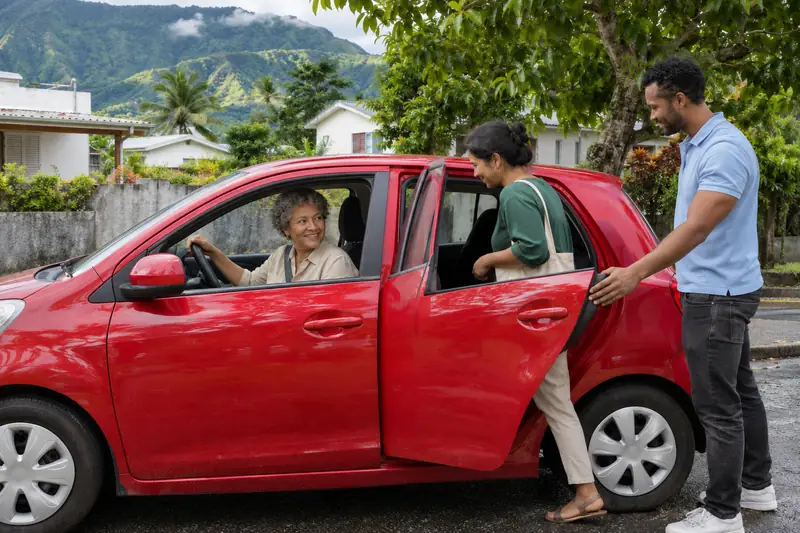
In Réunion, carpooling means a driver who is already travelling on the island offers seats to passengers going the same way, who contribute to the cost of fuel and running costs. It is used above all by commuters between the south, the west and the capital, Saint-Denis, where roads are saturated at rush hour. The island is mountainous and compact, public transport does not cover every area, and car use is high, so shared journeys on the island can reduce costs, stress and congestion.
Why carpooling matters in Réunion
Réunion is a small, mountainous island with a population concentrated on the coast. Jobs, universities and services are clustered in a few poles such as Saint-Denis, Saint-Pierre, Saint-Paul, Le Port and Saint-André, while many people live in the hills or in residential areas some distance away. The result is a heavy reliance on cars and long queues at peak times on the main axes.
The coastal road and the Route des Tamarins carry most of the traffic between the west, the south and the north. A single accident or a rockfall can paralyse movement, and rain or cyclones aggravate the situation. Reducing the number of cars is a local priority, and carpooling is one of the tools mentioned by the island's authorities.
Sharing a vehicle can save money on fuel and parking, and reduce time spent searching for a space in town centres.
Aires de covoiturage and meeting points
The island has developed carpooling areas, called aires de covoiturage, near major junctions, for example around Saint-Paul and La Possession. These are car parks where drivers and passengers meet to continue the journey in a single vehicle. They are convenient for people who live in different places but travel along the same corridor.
Using a designated area has practical advantages. The location is easy to find, there is room to park cars during the day, and the meeting point is known by everyone in the group. It also reduces the number of vehicles entering congested town centres.
Before choosing an area, check opening conditions, lighting and security, and whether it is close to the motorway or main road you use. Agree a precise time and leave your phone number with the other members of the group.
Apps, groups and local initiatives
Rides on the island are arranged in several ways. National services such as Mobicoop, a cooperative platform, are available to people in Réunion, and local groups on social networks help match drivers and passengers. Employers and public bodies sometimes organise their own internal schemes, and local associations focused on sustainable mobility promote carpooling in the island's communities.
Regional and departmental authorities have published plans for sustainable mobility that include carpooling, park-and-ride and improved public transport. Information about these initiatives is available through their websites and local offices.
Choose a service with verified profiles when you can, and prefer arrangements with colleagues or neighbours when you need regular journeys. A stable group simplifies planning and builds trust over time.
Sharing the cost fairly
Costs on the island mainly concern fuel and wear on the vehicle. Réunion has no motorway tolls, so the expense is lower than in some other regions, but daily commuting still adds up, especially for longer routes from the south to Saint-Denis. Parking in town centres can also be a significant cost.
A fair method is to divide the total costs of the trip, including parking if the driver pays for it, among all those in the car. Some groups agree on a monthly sum, and others rotate drivers each week so that nobody pays the others.
Remember that carpooling is meant to share costs, not to create income. Keep payments modest and consistent with the real costs, and settle accounts regularly to avoid misunderstandings. In case of doubt, write the arrangement in a short message that everyone can see.
Insurance and road rules
French motor insurance rules apply in Réunion, and the driver's liability policy normally covers passengers. Drivers who carpool regularly should tell their insurer and confirm that cost sharing is acceptable. Keep the vehicle's documents and technical inspection certificate up to date.
Road safety deserves attention. The island has winding roads, sudden rain and steep sections in the hills, and the combination of fatigue and congestion can be dangerous. Seat belts are mandatory for all occupants, children must be in suitable seats, and speed limits are checked by cameras and patrols.
- Slow down in rain and avoid flooded roads.
- Take care in areas where rockfalls are possible.
- Follow the instructions of the authorities during cyclone alerts.
Never continue a journey if the conditions are unsafe, even when you have promised to meet others.
Commuting between the south, west and Saint-Denis
The main commuting flows run along the coast, from the south and west towards Saint-Denis and from the interior towards the coastal towns. Colleagues who work in the same sector, such as the administration, the university or the hospital, can organise a rota with a fixed departure time and a meeting place.
Leaving fifteen minutes earlier or later can change the journey time significantly, so flexible hours help carpoolers. Employers can assist by adjusting schedules, providing reserved parking and publicising existing groups.
When the coastal road is closed or restricted, carpooling becomes even more valuable, as it reduces the number of vehicles trying to use alternative routes. A group that already exists is ready to adapt when conditions change, whereas a newcomer might find it harder to organise a ride at short notice.
Leisure, hikes and the cirques
Carpooling is not limited to work. Visitors and residents also share cars to reach hiking trails, beaches and the island's three cirques, Cilaos, Salazie and Mafate, although Mafate has no road access. Roads to Cilaos and Salazie are narrow and winding, parking at popular trailheads is limited and early starts are common.
Hikers often meet at a car park and continue in a single vehicle. This reduces the number of cars at trailheads, eases parking pressure and lets one driver focus on the road while the others enjoy the view. After a long walk, a shared lift back to the starting point is particularly useful.
Always check the weather forecast and trail conditions before setting off, and tell someone where you are going. Conditions in the mountains can change quickly and affect both the road and the walk.
Starting a carpool group on the island
Start with the people you already see every day: colleagues, neighbours and parents at your children's school. Ask who travels the same way and at what time. A small group of three or four people is easy to manage, and a messaging group helps with everyday coordination.
Agree on departure points, waiting time and payment. Share the contact details of each member and the registration of the car. Review the arrangement after a few weeks and adjust where needed.
Keep a backup plan, such as the Car Jaune interurban coach network or a taxi, for days when the group cannot travel. Being flexible and respectful helps the group last. Over time, a reliable carpool can save a considerable amount on fuel and parking and make daily life on the island more pleasant.
Carpooling and mobility organisations in Réunion
- Mobicoop : French cooperative carpooling platform with no commission, usable for journeys across the country including overseas departments.
- Car Jaune : Interurban coach network of Réunion, a useful alternative or complement to carpooling.
- ASPRO MOD : Association of sustainable mobility professionals in Réunion, promoting alternatives to solo driving.
Further reading
- Région Réunion : Regional authority that publishes information on mobility plans and carpooling on the island.