
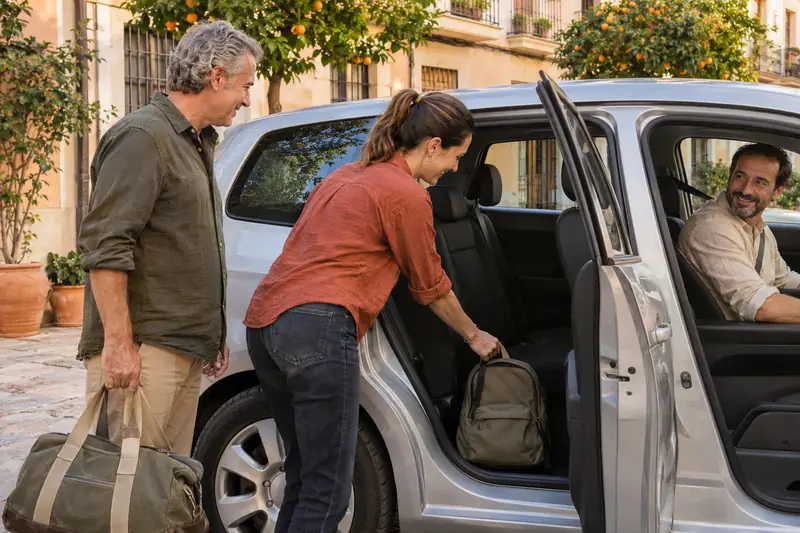
In Lyon, car sharing between individuals is the practice of lending a privately owned car to another person for a fee, either through a platform that handles bookings and cover or through a direct agreement. It gives owners a way to share running costs and gives borrowers access to a vehicle for an evening, a weekend or a longer trip. In a city with a large public transport network, it is mainly used for the journeys that trains, metro lines and bikes do not cover.
In Lyon, car sharing between individuals for occasional journeys
Lyon has metro lines, trams, buses and a large bicycle-hire scheme, and many residents of the Presqu'île, the Croix-Rousse slopes or the Part-Dieu district use a car only a few times each month. For them, the cost of buying, insuring and parking a vehicle is hard to justify.
That situation creates two types of users. Owners who keep a car for family reasons lend it when it would otherwise stand still. Residents without a car borrow one for a trip to the Beaujolais vineyards, the Monts d'Or, the Alps or a visit to relatives.
Students and young professionals also appreciate that a short loan costs far less than ownership while giving more freedom than a rental counter open only during office hours.
Platforms and direct loans compared
There are two main ways to share a car between individuals. A platform lists vehicles, collects payment, provides a contract and usually includes cover during the booking. A direct loan between neighbours or colleagues is simpler but leaves all the paperwork and all the risk to the two people involved.
- Platform: more protection, a commission on each booking, standard rules.
- Direct loan: no commission, but you need your own written agreement and a clear insurance position.
- Cooperative car clubs: cars owned by an organisation rather than by individuals, with a subscription.
Owners who lend frequently tend to choose a platform, while two households that share a family car prefer a direct agreement. Whichever way you decide, make the rules explicit before the first trip.
Insurance questions every Lyon owner should ask
Before listing a car, call your insurer and ask three questions: does the policy allow other drivers, does it cover a paid loan, and what happens to the bonus after an accident caused by a borrower. Some policies exclude paid use altogether, which would leave you personally exposed.
Platforms normally provide their own cover for the duration of each rental. Read the conditions to learn the amount of the excess, the exclusions for certain drivers or vehicle types and the delay for declaring a claim.
Borrowers should check that their licence is valid for the car category and that the document is on them. A driver with a recent licence may face a higher excess or an age condition, so read the details before confirming the booking.
Driving rules and low-emission zones in Lyon
Lyon applies a low-emission zone that restricts some older vehicles according to their Crit'Air classification. An owner should know the classification of the car, display the sticker and mention it in the advertisement so that a borrower is not caught out.
Traffic is dense on the approaches to the city, including the tunnel under Fourvière and the A7 motorway, and parking in the centre is paid. Borrowers should plan their route and their parking before they leave and agree who pays for tolls, fuel and fines.
For a trip to the airport at Saint-Exupéry or to the stations of Part-Dieu and Perrache, the handover time must allow for rush hour. Late returns often cause more tension between owner and borrower than damage does.
What a fair price looks like
The price of a shared car should reflect the real cost of the vehicle, not a hope of profit. Add up the annual insurance, servicing, tyres and parking, then add depreciation. The result, divided by the number of days of loan, gives a baseline for a daily rate.
A distance allowance protects the owner on long trips. Many owners set a number of included kilometres per day and charge a small amount for each kilometre beyond it.
A borrower should compare the total with a short traditional rental and with a car club. The shared car should offer an advantage, such as a lower price, a vehicle closer to home or a model suited to the trip, otherwise the formula loses its purpose.
Handover, checks and returning the car
A careful handover prevents most disputes. At pick-up, the two people walk around the car, take timestamped photos of each side, the wheels and the interior, and note the mileage and the fuel or charge level.
- Check that the documents and the safety equipment are in the car.
- Test the lights, the indicators and the tyre pressure on a long trip.
- Agree the time and the place of the return.
- Repeat the photos at the end and compare them.
If a damage appears, report it immediately through the platform or in writing. Waiting several days makes it much harder to prove when it happened and may breach the conditions of the cover.
Tax and administrative points for owners
Income from lending a car must be recorded, whether the sum is small or large. Platforms usually give an annual statement of the amounts paid, and you should keep your own table with the date of each loan, the price and the expenses you want to compare.
The way the income is taxed depends on the amount and on the regularity of the activity, so check the official explanations or ask an adviser before you make assumptions. Costs shared with a friend for a single trip are generally treated differently from a regular paid loan.
Keep proof of everything for as long as the law requires, including the contract, the messages and the payment receipts, so that you can answer a question from your insurer or the tax office.
Seasonal and weekend use around Lyon
Lyon is a city of weekend departures. On Friday evenings, residents head for the Alps, the Ardèche, the Beaujolais or the lakes of the Ain, and cars that are reserved well in advance are the ones that get chosen. Owners can use this pattern to plan when they will lend their vehicle and when they need it themselves.
Borrowers should confirm the time of return, because Sunday evening traffic on the roads back to the city is heavy and a delay of an hour may block the owner's own plans. A shared calendar or a clear message avoids this problem.
During festival periods, such as the lights festival in December, centre-city parking becomes scarce and some streets close to traffic. In that case, agree on a handover point near a metro station instead of the owner's door, and plan the trip on public transport for the final stretch.
Organisations offering shared cars in Lyon
- Getaround : A peer-to-peer platform with cars in the Lyon area that can be unlocked with a smartphone.
- Citiz : A cooperative car-sharing network with stations in several French cities, including the Lyon area.
- Ubeeqo : A car-sharing service with vehicles in dedicated spaces near stations and business districts.
Further reading
- UFC-Que Choisir : Independent advice on rental contracts, insurance cover and consumer rights.