
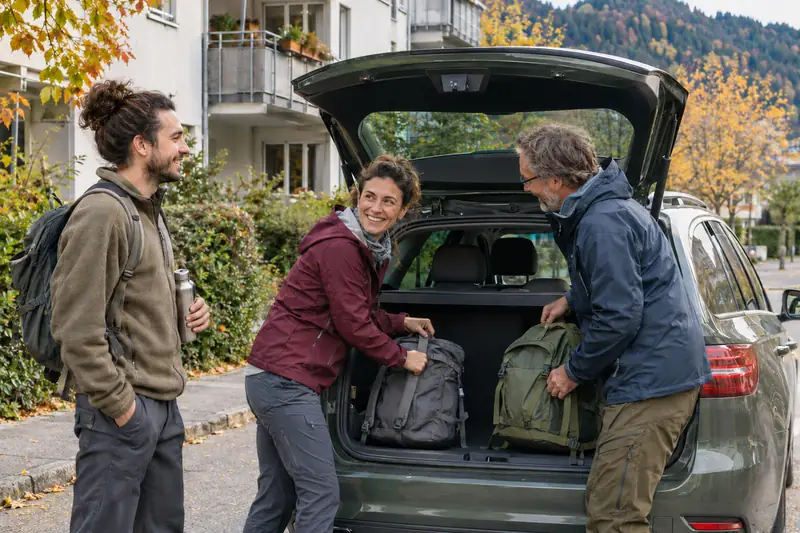
In Switzerland, carpooling is the practice of travelling together in a private car, with the driver offering free seats to passengers who contribute to the cost of the journey. It is organised through platforms, employers or local groups and is used for commuting, weekend trips to the mountains and cross-border travel. Because fuel, parking and car ownership are expensive in Switzerland, many people use carpooling to cut costs, while public transport remains the backbone of mobility for most daily journeys.
Carpooling in Switzerland: the local context
Switzerland has an excellent rail and bus network, so carpooling does not replace public transport in the way it can elsewhere. It fills gaps. Many people live in villages with limited evening services, work in industrial areas that stations do not reach, or travel to ski resorts and hiking trails where timetables are inconvenient.
Costs also play a role. Switzerland has high living costs, and parking in cities such as Zurich, Geneva, Basel or Lausanne can be expensive and limited. Sharing the car for a commute or an excursion therefore makes sense financially and reduces pressure on parking spaces.
Authorities in several cantons and cities encourage carpooling through mobility management programmes for businesses, which advise on parking policy and alternative modes of getting to work.
Platforms and local schemes
You will find international platforms such as BlaBlaCar active in Switzerland for intercity routes, along with Swiss and regional services designed for commuters. Some employers use specialised software to match colleagues, and large sites such as hospitals, universities and industrial campuses sometimes run their own schemes.
Compare the platforms by checking the language of the interface (German, French, Italian and English are common), the way payments are handled and how profiles are verified. A service available only on one side of the language border may be less useful if you travel between regions.
Do not forget informal channels. Community boards, university groups, sports clubs and village associations often organise rides for events and regular activities, with no platform needed at all.
What a shared journey costs
The amount requested should reflect a fair share of the real costs, namely fuel, wear on the vehicle and, where applicable, motorway charges. Swiss motorway use requires an annual vignette for the car, which the driver pays regardless of passengers, and some tunnels have separate charges.
Platforms usually propose a recommended price per seat, calculated from the distance, so that drivers do not make a profit and passengers know what to expect. For regular commutes, groups often prefer a monthly amount or a rotation of drivers.
Compare the cost with public transport, which is reliable but can be pricey for long distances without a season pass. A carpool seat may be cheaper on routes that are not well covered, though a half-fare card or a general pass may still be better for people who travel frequently by train.
Language regions and cross-border trips
Switzerland has four national languages and the language of a ride post often reflects the region: German in the north and east, French in the west, Italian in Ticino and Romansh in parts of Graubünden. English is widely understood in business contexts, but being polite in the local language makes a good impression.
Many drivers cross borders for work or shopping. Frontier workers travel daily between Geneva and France, between Basel and Germany or France, and from Ticino to Italy. Carpooling can reduce the stress of border queues and the cost of parking in the city centre.
When crossing a border, bring valid identity documents, check that the insurance covers the countries you travel through, and learn the rules for winter equipment, which may differ between countries. Platforms generally show the border crossings on the route.
Mountain and winter travel
Excursions to the Alps and Jura are one of the main reasons for sharing a ride. Skiers and hikers often leave before dawn and return in the evening, when buses may not run. A full car makes the cost of petrol, parking and mountain road fees easier to bear.
Winter calls for extra preparation. Winter tyres are strongly recommended and are an important part of safe driving in snowy conditions. Snow chains may be necessary on some passes, and road conditions can change fast. Drivers should check road reports before leaving and tell their passengers if a route is closed.
- Carry warm clothes and a charged phone.
- Agree in advance on the return time and a meeting point.
- Do not force a trip in dangerous weather.
Insurance, rules and responsibilities
Motor liability insurance is compulsory in Switzerland and covers injury to passengers. Drivers who carry others regularly should check their policy for any specific conditions. Carpooling should remain a sharing of costs rather than a profit-making activity; commercial passenger transport is subject to licensing rules and falls outside ordinary carpooling.
Traffic rules are strictly enforced. Seat belts are mandatory for all occupants, children need suitable restraints, and the alcohol limit for drivers is low. Speed controls are frequent, and fines can be high. Drivers are responsible for compliance with these rules and should not pressure anyone to bend them.
Passengers should be punctual and reliable. A late cancellation can leave a driver without the contribution they were counting on, so confirm any change early and use the platform's cancellation function.
Commuting by carpool in Swiss cities and regions
For commuters, carpooling is often the answer to a journey that public transport serves poorly, such as a trip between two rural communities or to a business park. Employers in several regions support their staff with mobility plans that include reserved parking for carpoolers, guaranteed return options in case of emergencies and information on alternatives.
Park-and-ride facilities at the edge of cities offer another useful combination. A driver can collect colleagues at a meeting point, travel together to the city's edge and continue by tram or train to reduce the number of cars in the centre.
If you want to start, speak to your employer's mobility manager, or ask colleagues who live near you. A small group with a clear schedule is easier to run than a large one.
Getting the most out of a shared ride
Good communication is the difference between a smooth journey and a stressful one. Confirm the pick-up place, which can be a station car park, a petrol station or a street corner, and agree on how long the driver will wait. Share a phone number, but protect your privacy by not giving more personal information than necessary.
Bring small luggage when possible, since boots are limited, and tell the driver in advance if you have skis, a bicycle or a pet. Offer to chat or to remain quiet, depending on the other person's preference, and thank the driver at arrival.
Most carpoolers rate their experience positively after a few trips. Take time to leave honest feedback to help others decide, and report problems to the platform so that it can maintain a trustworthy community.
Carpooling and shared mobility organisations in Switzerland
- BlaBlaCar Switzerland : Intercity carpooling platform with listings for journeys within Switzerland and to neighbouring countries.
- Taxito : Swiss carpooling service focused on regular commuter trips, with partners among employers and authorities.
- Mobility : Swiss car sharing cooperative with cars at stations across the country, useful when no carpool is available.
- PubliBike : Swiss bike sharing service that can complete a journey after a shared car ride.
Further reading
- Touring Club Switzerland : Swiss mobility club with information on driving, insurance, road conditions and travel.