
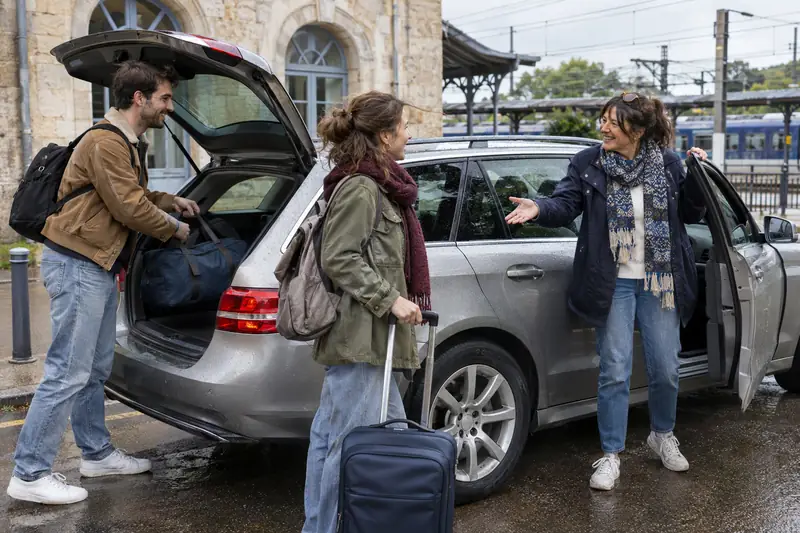
Cross-border carpooling is a shared car journey in which a driver who lives in one country and works in another takes passengers making the same daily trip across the frontier, in exchange for a share of the costs. It is a common answer to congested border roads, expensive parking in business districts and limited cross-border public transport. The arrangement involves the same principles as any pool, with extra points to check on insurance, taxation, tolls, currencies and border formalities for every member.
Who uses cross-border carpooling and why
Frontier workers are people who reside in one country and work in a neighbouring one. They are especially numerous around Luxembourg, Geneva, Basel, Lille, Strasbourg and Aachen, but similar flows exist on many borders across Europe and North America. Most make the trip every day, often in the same hours as thousands of others, which saturates the roads close to the border.
- Employees who cannot rely on a direct train or bus line.
- Shift workers whose hours do not match public transport timetables.
- People who prefer to avoid costly daily parking in the destination city.
For all of them, sharing a car reduces the monthly bill and the stress of driving alone in heavy traffic.
Costs shared across the border
The cost of a cross-border trip is made up of fuel, tolls, parking at the workplace and wear on the car. Fuel prices often differ between neighbouring countries, and many drivers fill up on the cheaper side. The group should agree on whether to take this into account or simply use a flat monthly amount.
Some motorways require a vignette or a toll sticker. Switzerland, for example, uses an annual vignette for its motorways, and some neighbouring countries have distance-based charges. These costs should be included in the group's budget. Parking in the destination city can be expensive, and the driver who holds the parking pass may ask the others for a share. A written monthly summary avoids arguments and makes the arrangement transparent, even when currencies differ between the two countries.
Insurance, licences and vehicle rules
Motor insurance is generally valid across neighbouring countries, particularly within Europe where the green card system and common rules apply. Even so, you should check that your policy covers regular use for commuting abroad and the carriage of passengers who share costs. Insurers can confirm this in writing.
- Carry the driving licence, registration papers and insurance certificate.
- Check any national equipment requirements, such as winter tyres, reflective vests or emission stickers.
- Confirm whether the vehicle needs an environmental sticker to enter certain low-emission zones.
Rules on speed, alcohol limits and mobile phone use differ between countries, and a driver crossing the border every day should know both sets. Fines issued abroad can be followed up through cross-border cooperation, so ignoring them is not a good idea.
Taxes, social security and your employer
Carpooling does not change the tax or social security position of a frontier worker, which is governed by agreements between the countries concerned. Nevertheless, some commuting costs may be deductible in one country but not in the other, and the rules on shared journeys vary. It is advisable to ask a tax adviser or the human resources department about the treatment of commuting costs and any mobility allowance.
Some employers offer financial support for pooling, such as a bonus, priority parking or a guaranteed return option when someone has to stay late. Others have agreements with local authorities or platforms. Keeping a record of the days on which you travelled and the amounts paid to the driver can be useful if questions arise. A pooling arrangement should always stay within cost-sharing and not become a source of income.
Finding partners for a regular cross-border trip
Start with your own workplace, since colleagues share the same destination and hours. Many large employers and business parks have mobility coordinators or internal groups for matching. Regional authorities and cross-border cooperation bodies may also run platforms, and some general carpooling services offer filters for commuter routes.
- Look for people who live in the same village or along the same road.
- Check start and end times, as well as flexibility for overtime.
- Decide whether you accept passengers of both nationalities and languages.
A short meeting before the first trip allows you to discuss habits and expectations. When languages differ, agree on a common language for messages so that last-minute changes are understood by everyone.
Border formalities and traffic at the frontier
Within areas where border checks are normally absent, crossing may be seamless, but temporary controls can appear without warning. Carry an identity document or passport for every passenger, even if it is rarely checked. Non-EU nationals living in the border region should confirm the documents they need to cross and to work.
Queues at the frontier can add time to the trip, particularly when controls are reintroduced or when roadworks narrow the lanes. Traffic apps and radio bulletins give early warning, and flexible departure times can avoid the worst delays. Some borders have dedicated lanes or crossings for commuters. Knowing the alternatives, such as secondary roads or a nearby bridge, helps the group decide quickly when the main route is blocked.
Alternatives and combinations with public transport
Cross-border rail and bus lines have improved in several regions, with direct trains and integrated tickets. For many workers, a combination of shared car and rail works best: pool to a station on one side of the border, then continue by train to the workplace. This reduces the time spent in traffic and the parking cost in the destination city.
Compare the monthly cost of a season ticket with the share of costs in a pool, taking into account reliability and the time spent waiting. Remote working, when available, can reduce the number of days spent travelling and may simplify the arrangement for all concerned. Revisit the decision from time to time, since timetables, tolls and employer policies change. If the line is cut by a strike, a pool already organised can become the fallback that keeps everyone at work, which is another reason to keep the group alive.
Keeping the group stable over time
Cross-border pools live longer than most, because the journey is long and the savings are real. Their success depends on clear rules about waiting times, absences and the replacement of members who change jobs. Agree on how much notice is needed before leaving the group, and keep a list of potential substitutes.
Share information about road closures, strikes and weather, which can affect crossings. Keep communications polite and constructive, and review the arrangement every few months. Offering small gestures, such as buying coffee on Fridays, builds goodwill. A stable group saves money, reduces stress and makes the daily crossing a shared routine instead of a solitary chore. When someone leaves, the group should welcome a replacement quickly, explain the rules calmly and hand over the key arrangements, such as the meeting point, the payment method and the usual route when the motorway is blocked.