
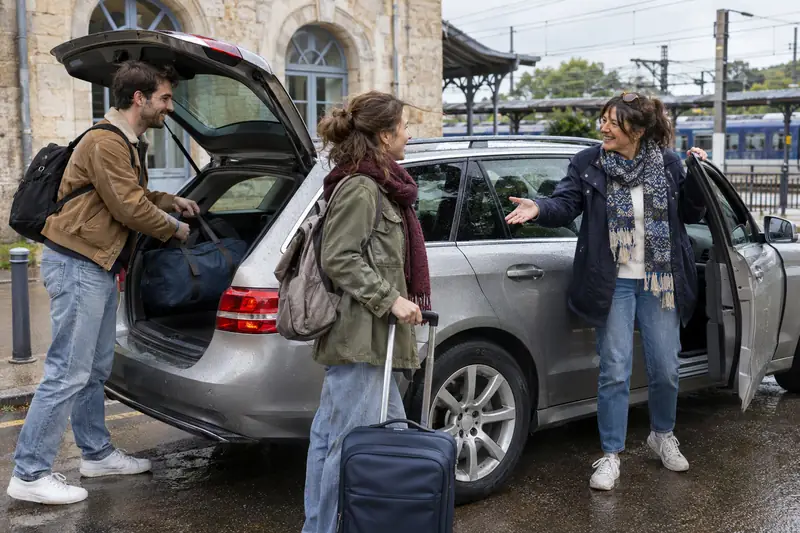
In France, carpooling is a service in which a driver who is already making a journey offers the empty seats in a private car to passengers heading the same way, in return for a contribution to the costs. It is usually arranged through a platform or app that puts drivers and passengers in touch. The driver does not make a profit: the money covers fuel, tolls and a share of the running costs, and is divided between everyone on board, the driver included.
What the law means by carpooling in France
French law treats carpooling as a shared journey made without profit. The driver chooses the route for their own reasons, such as getting to work or visiting family, and takes passengers along. The amount requested must stay within the real costs of the trip, which are mainly fuel and motorway tolls, divided by the number of people in the car, driver included.
This distinction matters. A person who runs a regular paid transport service with a private car, charging more than the costs, risks being treated as an unlicensed taxi or passenger transport operator. For that reason, reputable platforms cap the price a driver can ask for a given distance and show the passenger the exact amount before booking.
If you are unsure, remember the simple test: the trip would have happened anyway, and nobody earns money from it.
Finding a ride or offering seats
Most carpooling in France is organised through apps and websites, and the process is similar everywhere.
- Create a profile with a photo, a short description and a verified phone number.
- As a passenger, search by departure town, destination and date, then compare the offers.
- As a driver, publish your route with the time, the meeting point, the number of seats and the price per person.
- Confirm the booking through the platform, or accept the request if the driver validates passengers manually.
- Meet at the agreed place, check the identity of the other party and travel.
Reading the profile, the ratings and the comments left by previous travellers helps you decide whom to trust.
Costs and how the price is set
A typical contribution depends on distance, fuel and tolls. On a long motorway journey, a passenger often pays a fraction of what a train ticket would cost, particularly when booking at short notice, though this is not guaranteed on every route. For short daily trips, the contribution may be only a few euros or even a simple turn-taking arrangement between colleagues.
Platforms usually add a service fee for the passenger, which is displayed before payment, while the driver receives the rest. Some services also hold the payment until the trip is completed, which protects both sides if the driver cancels.
As a driver, calculate your real costs honestly. Include fuel and tolls, and keep in mind that wear on the car is already a cost you bear whether or not you take passengers. The aim is to lower the bill, not to create income.
Carpooling for the daily commute in France
Many French employees share their journey to work, either with colleagues or with neighbours who follow the same road. A fixed group is the simplest arrangement: each person drives on certain days, or everyone pays the driver a monthly amount. It requires little organisation once the schedule is set.
Employers can help by creating internal ride boards, providing priority parking or taking part in a company mobility plan. Some local public transport networks run their own carpooling services for commuters, and incentives may be offered for regular users, though the details change by area and over time.
Agree early on what happens when someone is ill, works late or takes a holiday. A simple group message and a clear rule on waiting times, such as five minutes at the pick-up point, keep the arrangement working over the long term.
Everyday and long-distance uses
French carpooling covers two quite different needs. Long-distance trips connect big cities, universities and holiday regions on busy weekends, when trains are full. Short, regular trips link home with workplaces, schools, stations and industrial estates where public transport is limited.
Rural areas benefit in particular. Where there is one bus a day, a shared car can be the only practical alternative to owning two vehicles. Many local authorities and employers encourage it with parking areas near motorway junctions, reserved places for carpoolers, or financial incentives for commuters.
Event travel is another common case: festivals, football matches, ski resorts and exhibitions often have their own ride boards. Always agree in advance on the pick-up place and the return time, because a shared trip depends on everybody keeping to the plan.
Insurance, safety and responsibilities
The driver's motor insurance normally covers passengers who are carried free of profit, but conditions vary between policies. It is worth asking your insurer to confirm that regular carpooling is allowed and whether any additional guarantee is useful, especially for frequent trips.
- Check that the driver holds a valid licence and the car is roadworthy.
- Share your journey details with someone you trust.
- Use the platform's messaging rather than moving to private channels too early.
- Wear a seat belt on every seat, and respect speed limits and rest breaks.
- Report any behaviour that worries you to the platform.
Passengers are expected to be on time, pay the agreed amount and treat the car with care. A short, polite exchange before the trip avoids most misunderstandings.
Benefits for the environment and traffic
A car carrying four people instead of one removes several vehicles from the road for the same journey. This reduces congestion at peak times, lowers the emissions per traveller and eases the pressure on parking in town centres. Because the journey was going to happen anyway, the extra impact of picking up passengers is small.
For households, the benefit is financial as well: sharing fuel and tolls can make a long weekend away far cheaper. For regions with weak rail links, it fills gaps between timetables. Authorities in France have promoted it for years through dedicated lanes on some busy roads, apps run by local transport networks and information campaigns, in the hope that more drivers will fill the empty seats that travel on French roads every day.
Mistakes to avoid
Several problems come up again and again. Agreeing on the price outside the platform can leave you without protection if the trip is cancelled. Arriving late, or failing to warn the others, damages trust and ratings. Drivers who quote a price above the real cost can fall foul of the rules described above.
Passengers should avoid bringing bulky luggage without asking, since boot space is limited. Drivers should state clearly whether smoking, pets or music are acceptable. Both sides should confirm the pick-up point precisely, because a station or a car park can have several exits.
Finally, keep a backup plan for important journeys such as a flight or an exam. Carpooling is flexible and cheap, but it relies on one private driver, so a spare option avoids stress if plans change.
Carpooling platforms in France
Further reading
- Mobicoop : Cooperative, non-profit carpooling platform.