
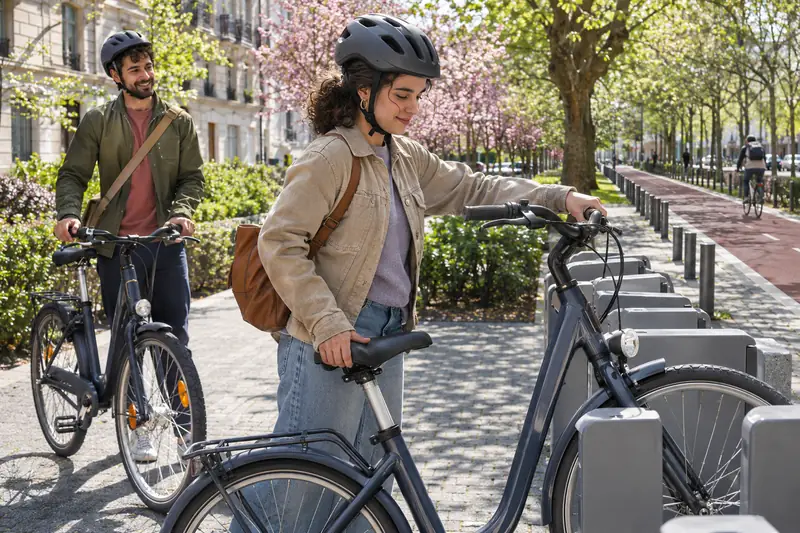
Bike sharing is a service that gives people access to bicycles without buying one, with the user paying for the time the bike is used. Cycles are unlocked with a card, code or smartphone, ridden to a destination and returned to a docking station or left in an authorised area. Schemes operate in many cities, run by local authorities, transport networks or private companies, and include standard pedal bikes, electric-assist models and cargo bikes for carrying shopping, luggage or children.
Docked and dockless bike sharing
Two layouts dominate. In docked schemes, bicycles are locked at stations with a number of bays. You take a bike from one station and return it to any station with a free space, so planning the end of the journey matters when an area is busy. Station maps and live availability are shown in the scheme's app.
In dockless schemes, bikes are fitted with their own lock and tracker. They can be picked up wherever you find one and parked in permitted places, often marked on the map. This is flexible, but poorly parked bikes can obstruct pavements, so operators and cities define zones and penalise misuse.
Some cities combine both approaches, and others offer long-term rental of a personal bike on a monthly basis, which is a different service although closely related.
Registering and unlocking a bike
Registration is usually done in the app. You enter your details and a payment card, accept the terms and choose a pass. Many schemes offer a single-ride option, a day pass and a longer subscription, so you can match the product to your habits.
- Find a bike on the map and check that it shows as available.
- Scan the code on the frame or enter the number at the station.
- Adjust the saddle height and check brakes, tyres, bell and lights.
- Ride, using the cycle lanes where they exist.
- Lock the bike at a station or in a permitted zone and confirm in the app.
If a bike is faulty, report it and choose another before you set off.
What bike sharing costs
Prices are designed to favour short trips. Many schemes include the first half hour in a subscription and charge extra for longer use, which encourages quick turnover. Casual users usually pay per ride or per day at a higher unit price. Electric bikes cost more per minute than pedal bikes because the batteries and maintenance are more demanding.
An annual or monthly pass is often better value if you ride on most working days. Students, residents or low-income users sometimes receive reduced rates, depending on the area. Public transport passes may include a bike share option.
Always check the deposit or pre-authorisation on your card, and what happens if you do not return the bike within the allowed time. Some schemes charge a penalty or treat a long absence as a loss.
Safety on shared bicycles
A shared bike is not always set to your size or weight, so a quick check is vital. Squeeze both brakes, spin the pedals, look at the tyres and make sure the lights work if you ride at dusk. Adjust the saddle until your leg is almost straight at the lowest point of the pedal.
- Wear a helmet where possible, even when the law does not demand it.
- Use lights and reflective clothing at night.
- Keep a safe distance from parked cars to avoid opening doors.
- Give way to pedestrians on shared paths.
- Do not ride after drinking alcohol.
Electric models are heavier and quicker to accelerate, so build confidence on a quiet street first.
Who uses bike sharing and why
The typical user is a city dweller making short, frequent trips, such as the stretch between a station and an office, an errand within a few kilometres or a ride to a leisure venue. For these distances, a bicycle is often as fast as a car or tram once parking and waiting are included.
Tourists use shared bikes to explore at their own pace without the weight of carrying a bike. Commuters use them as a flexible link in a longer journey that also involves a train or bus. Households that do not own a bicycle can borrow one for occasional rides on weekends.
Because no storage, maintenance or theft risk falls on the user, the service attracts people who have no space for a bike at home, which is common in small flats.
Benefits for cities and health
Cycling replaces short car trips, which are the most polluting per kilometre because engines are cold, and it takes pressure off crowded buses and trams. For public authorities, a shared network is a way to offer mobility without large construction work, and the bikes can be moved to follow demand.
For the rider, regular cycling is a gentle form of exercise that is easy to fit into a daily routine. Even short trips add up over a week, and many users report that cycling makes their commute more predictable than driving in heavy traffic.
Results depend on the quality of the infrastructure. Where cycle lanes are continuous and protected, usage grows quickly. Where riders must share busy roads with fast traffic, many people stay away, whatever the price of the pass.
Tips for a smooth experience
Check the live availability before you walk to a station, as a popular spot can be empty at rush hour and full at the end of the day. Plan the end point too: if the destination station is full, nearby ones are normally shown in the app, and some schemes give a few extra minutes of free time in that case.
Carry a small lock only if the scheme allows you to pause a trip outside the zone. Keep a charged phone, since unlocking depends on it. Take a photo of the bike after parking, which protects you if the system does not register the end of the ride.
Finally, learn the local rules for cycling: some cities restrict riding on pavements, require lights after dark or have special rules for electric bicycles. A few minutes of reading saves fines and awkward situations.
Bike sharing for visitors and newcomers
Visitors can use most schemes, but they should check a few points before relying on one. Some systems accept foreign payment cards without difficulty, while others need a local phone number or a specific app. Day passes are the simplest choice for a short stay, and they remove the need to understand a complex tariff.
Newcomers who have just moved to a city often use shared bikes while they decide whether to buy their own. Riding the same route at different times of day shows how safe and practical cycling is for them.
Ask the tourist office or the scheme's customer service about nearby cycle routes, rules on helmets for children, and whether baskets or child seats are available on certain models. Keep in mind that rules on riding at night and on pavements vary from place to place.