
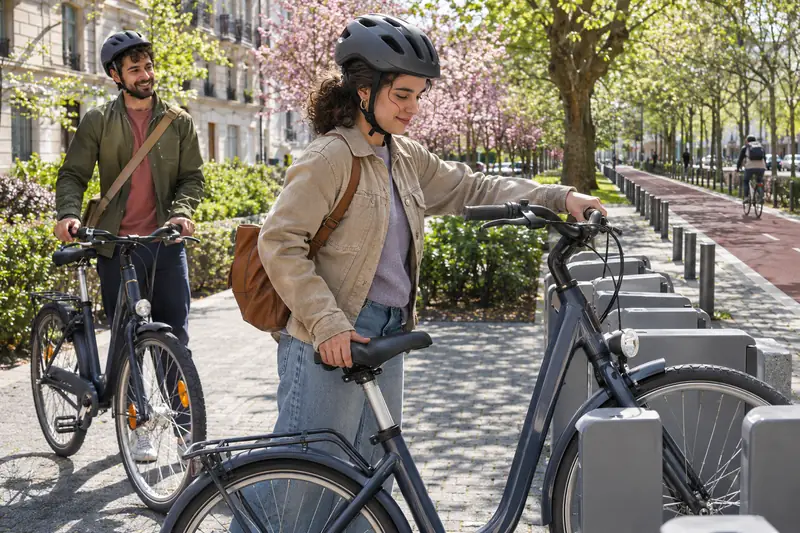
In Switzerland, bike sharing allows you to take a bike or e-bike for a short journey, a day or longer without owning one, either from a station network, a free-floating service, a railway station rental point or from a private person. Cities such as Zurich, Bern, Basel, Geneva and Lausanne have schemes, and many smaller towns and regions have local offers. You register in an app, unlock the bike, and return it according to the operator's rules. Prices and areas differ by region, so check the provider before riding.
Bike sharing in Switzerland: what the networks look like
Swiss systems are often run by private companies in cooperation with cities, transport companies or regional authorities. Station-based networks let you take and return bikes at fixed points. Rail-station rental points are available for visitors who want a bike for the day. Some regions also offer tourist e-bikes with battery exchange stations along cycling routes.
- Urban sharing for short daily trips.
- Day rental at stations and tourist offices.
- E-bike hire for hills and long routes.
- Private lending platforms for specialised bikes.
Because Switzerland has hills and mountains, many travellers prefer e-bikes. Look at the elevation of your route before choosing the bike type, and check the range of the battery.
Registering, passes and prices
Registration is usually done through an app with a payment card. Operators offer single rides, day passes and annual subscriptions, and some town residents receive reductions. Charges are often based on the time you use the bike, with electric models costing more per minute.
- Check whether the first minutes are free in your pass.
- Look at the maximum fee per day.
- Read the terms about deposits or card pre-authorisation.
- Check whether your public transport pass gives a discount.
Prices are in Swiss francs and can change, so look at the operator's official page for the current rates. Tourists should check the rules about foreign payment cards and the language of the app, which is usually available in German, French, Italian and English.
Read the section on damage and late return carefully, because fees are often calculated per hour.
Combining bikes with trains and buses
Switzerland's public transport network is one of the most developed in Europe, and bikes fit well into it. A shared bike is a practical way to cover the first or last kilometres from a station, especially in towns that are not on a tram line.
- Many stations have bike parking and rental points.
- Some operators partner with transport associations for combined passes.
- If you take your own bike on a train, a ticket may be required, so check it before the trip.
For hiking and cycling excursions, plan your route using the national cycling route network and check that your return station has a drop-off point if your rental requires it. Some mountain routes have steep sections and no stations, so a return to your starting point may be simpler.
On sunny weekends, popular rental points can run out of bikes, so book or arrive early where reservation is possible.
Road rules for cyclists in Switzerland
Cyclists must follow the traffic rules, use cycle lanes where they exist and give way where signs require it. Lights are mandatory at night and in tunnels, and white front and red rear lights are required for e-bikes as well.
- A helmet is not legally required for adults on ordinary bikes, but it is strongly recommended.
- Fast e-bikes, which reach higher speeds, are treated like mopeds and require a helmet and a licence plate.
- Do not use a handheld phone while cycling.
- Take care in tram tracks and on wet paving.
Pedestrian zones may be open to cyclists at walking speed. Always check signs, since local rules can differ between towns and cantons.
Before an evening ride in the mountains, switch the lamps on and test them while still at the rental point.
Switzerland's regions and languages
The linguistic regions affect services. German-speaking cities often have denser schemes, while French-speaking and Italian-speaking areas have local systems and rental points. Tourist regions, such as Valais, Graubünden or Ticino, often offer e-bikes for rent at hotels, stations and tourist offices.
- In large cities, look for station-based systems and apps.
- In tourist areas, check the opening hours of rental points, which may be seasonal.
- In small towns, ask at the tourist office or municipality.
If you ride into another canton, check that your rental allows you to leave the home area, since some systems define zones and charge for returns outside them.
Private bike sharing and lending
Individuals sometimes lend or rent out bikes through neighbourhood networks and platforms. It is a good option for cargo bikes, children's bikes or high-quality e-bikes that are not offered in public schemes.
- Agree on the price, the deposit and the return date in writing.
- Ask the owner about insurance and what happens if the bike is stolen.
- Check the brakes, tyres and lights before leaving.
- Return the bike with the battery charged.
Remember that you may be liable for damage if the owner's insurance does not cover rentals. A short note on the condition of the bike, signed by both parties, offers useful protection.
Insurance, theft and liability
Operators usually describe their insurance in the terms of use. You are generally liable for damage caused by misuse and for the excess in case of theft if you did not lock the bike correctly. Private liability insurance is common among residents and often covers accidents caused to others.
- Report any damage or accident through the app.
- Lock the bike with the provided device at a proper stand.
- Do not leave e-bikes in a place where they block access.
- Take photos at the beginning and the end of the ride.
Visitors should check whether their travel insurance includes cycling accidents, since medical costs in Switzerland can be high.
Practical tips for a good ride
Plan your route using the official cycle route maps and be realistic about hills. A short test ride helps you adjust the saddle and learn the brakes. Carry a rain layer and a small light, since weather in the mountains changes rapidly.
- Check the operator's map to confirm stations near your destination.
- Keep your phone charged for unlocking and navigation.
- Return the bike on time to avoid additional fees.
- Keep the confirmation email of every ride.
If you stay several days, a pass for a week or a month is often cheaper than separate rides. Compare it with a day rental from a shop, which may include a helmet and a lock.
Finally, respect pedestrians on shared paths, a courtesy that is strongly expected in Swiss towns.
Bike sharing organisations in Switzerland
- PubliBike : A Swiss bike and e-bike sharing network operating in many cities and regions.
- Donkey Republic : An app-based bike rental operator available in several Swiss locations.
- Rent a Bike : A bike rental service at many Swiss railway stations, with day rental and e-bikes.
- Pro Velo Schweiz : A national association promoting cycling, with local branches and information for cyclists.
Further reading
- SchweizMobil : The national platform for cycling, hiking and other routes in Switzerland, with maps and advice.